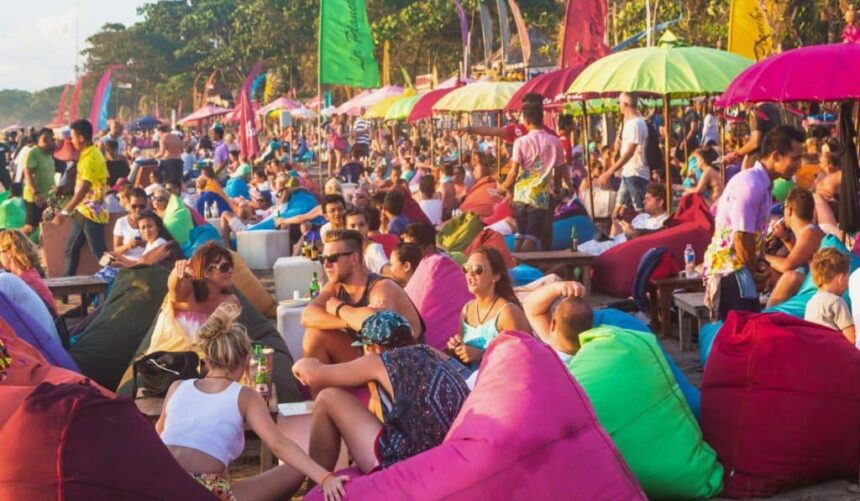
A familiar claim circulates on social media every year: Bali is “quiet,” “empty,” or “not worth it right now.”
On December 24, 2025, Bali’s top official moved to publicly rebut that narrative, calling it misinformation rather than a measurable downturn.
During a visit to Benoa Port in Denpasar, Governor Wayan Koster dismissed year-end “tourism downturn” posts and said, “We recorded an increase in tourism visits, which means that (tourism downturn claims) on social media is a hoax.”
The governor’s rebuttal was paired with concrete counts. Local news outlets say Bali has received 6.8 million foreign tourists year-to-date, surpassing the 6.3 million recorded in 2024, with daily foreign arrivals averaging about 20,000 between December 19 and 22.
On top of the above numbers, reports show that Bali is expected to receive over 1,5 Million visitors during this Christmas holiday,
Why Bali can feel “busy” and “uneven” at the same time
The “empty Bali” debate is less about total arrivals and more about where travelers are staying and spending.
Bali Expat, summarizing local reporting, quoted Koster emphasizing that arrivals have increased, but hotel occupancy has not always risen in parallel, which he linked to growth in non-hotel accommodation such as Airbnb-style stays.
That split matters for what visitors experience. Certain hotel zones may report softer occupancy, while road corridors, beach clusters, and villa-heavy neighborhoods remain crowded—especially in South Bali during late December.
The strongest real-time indicator: airport traffic

Beyond tourism-tally comparisons, airport throughput is an immediate proxy for whether an island is “empty.” ANTARA reported that I Gusti Ngurah Rai International Airport recorded 126,152 passengers in domestic arrivals and 192,960 in international arrivals from December 15 to 23, along with an average of 67,112 arriving passengers per day and 423 flight movements during the same period.
For travelers, that signals two practical outcomes: transport demand remains high, and late-December congestion is more likely to show up as traffic and transfer delays than as empty beaches.
The bigger constraint this week: weather volatility, not a tourism collapse

If there is a short-term variable reshaping what visitors “feel” day to day, it is the weather. Indonesia’s meteorology agency, BMKG, has been mapping heavy-rain risk during the Christmas and New Year travel window and emphasizing Java, Bali, and Nusa Tenggara for heightened safety monitoring.
At a Climate Outlook 2026 press conference, BMKG head Teuku Faisal Fathani said: “For Java, Bali, and Nusa Tenggara, the rainfall is expected to peak in January, making it a primary focus for safety during the Christmas and New Year holiday period.”
Another local news outlet has echoed those warnings with operational detail and summarized BBMKG guidance forecasting “moderate to heavy rain” across multiple regencies—including Badung, Denpasar, Tabanan, and Gianyar—alongside strong-wind and sea-state cautions in southern straits and waters.
What travelers should actually expect over the next several days
The most useful takeaway is not whether Bali is empty. It is how to plan around high demand plus rain-season variability:
Crowds and traffic: Expect busy conditions in South Bali’s core tourism belt. Even if a beach looks quiet at a given hour, road travel can still be slow—especially around transfers to and from Denpasar and the airport.
Price behavior: With strong arrivals, popular villa inventory and reliable drivers can book out faster. Deals exist, but they are more likely outside the most concentrated southern neighborhoods.
Weather risk management: Build flexibility. Keep indoor alternatives for heavy-rain days, avoid cliff-edge viewpoints in downpours, and treat marine warnings seriously when booking fast boats or coastal excursions.
Information hygiene: If the “Bali is empty” line is being used to sell you an unverified tour, a too-cheap villa, or a suspicious transfer, treat it as a risk signal—not a market insight.
Koster’s “hoax” rebuttal is not just political messaging; it’s a reminder to prioritize primary indicators—arrival counts, flight movements, and official weather advisories—over social chatter. The most accurate snapshot for late December 2025 is straightforward: Bali is receiving substantial year-end traffic, and the planning constraint travelers should take seriously is rain-season disruption, not a sudden tourism downturn.