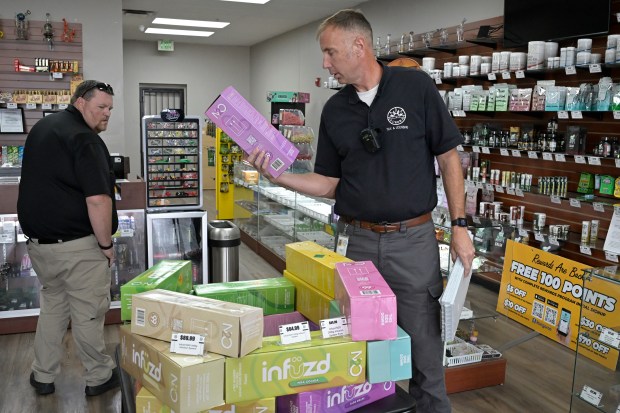
Aurora’s elected leaders have taken the first step toward making it harder for high school- and middle school-aged kids to get their hands on tobacco products that experts say are addictive and especially harmful to developing brains.
The City Council on Monday night unanimously approved a retail tobacco licensure ordinance on first reading. It aims to reduce underage access to tobacco products, like e-cigarettes and vaping cartridges, by stiffening fines on businesses that sell those products to people under age 21, while tightening rules on where tobacco retailers can set up shop in the city.
The ordinance would also cover sales of kratom and certain psychoactive hemp products to minors, and it would give the city greater oversight of hookah lounges.
The new law, which will be up for a final vote next month, would not ban the sale of flavored tobacco products, as was authorized by voters in neighboring Denver last fall.
“The primary concern for us is that these products are targeted towards youth,” said Trevor Vaughn, Aurora’s manager of licensing. “We’re addressing youth access to and usage of the products.”
It’s a move that Aurora Partners for Thriving Youth, a nonprofit coalition, has been advocating for.
“In Aurora, we have a problem with tobacco retailers selling tobacco to our youth,” said Alison Reidmohr, a member of the advocacy group. “It would improve the resources for doing age-compliance checks at retailers.”
Aurora Partners cites the 2023 Healthy Kids Colorado Survey that found nearly 84% of Aurora youth who attempted to buy tobacco or vape products in stores were able to do so, despite not being of legal age. The city has about 340 tobacco retailers, and Aurora Partners says more than 100 of those outlets are located within 1,000 feet of schools and recreation centers.
During Monday night’s council meeting, Joyce Baker, a respiratory therapist at Children’s Hospital Colorado, said that while many people view tobacco as a “problem of the past,” its main addictive component, nicotine, “has simply changed forms.”
“Today our kids are exposed to an entirely new generation of products — like disposable vapes, e-cigarettes, pods, nicotine pouches — that are designed to be discreet, addictive and appealing,” she told the council.
Baker held up a picture of a vape device that closely resembled a doctor-prescribed asthma inhaler, allowing for “stealth vaping” by underage kids.
DeLisha Boyd, dean of students at Aurora’s Rangeview High School, told the council that responding to vaping has been “one of the biggest disciplinary actions we have to take” at the school. Students, she said, will often buy vape products in bulk and then resell them at school.
“Our kids are so addicted,” Boyd said.
Joe Miklosi, a lobbyist for the Rocky Mountain Smoke Free Alliance, an industry group that fiercely opposed Denver’s flavored tobacco ban, said his group was happy with Aurora’s proposed ordinance. His group advocates for 125 small vape stores in Colorado, 25 of which are in Aurora. Many of them are minority-owned, he said.
A sticking point was a provision in the initial draft of the ordinance that would have banned retailers from selling tobacco and vape products that the federal government hasn’t explicitly approved. That generated fear among vape shop owners that much of their inventory would be prohibited for sale, Miklosi said.
The provision was removed before the council voted Monday.
Miklosi said adults’ freedom to buy what they want must be protected, especially given the critical role vaping plays as a less harmful alternative to smoking.
Aurora’s ordinance follows a move by state lawmakers in 2020 to raise the minimum age to buy tobacco products in Colorado from 18 to 21. Aurora’s punishment for retailers that flout its new law will be tougher than the state’s.
A first violation is set at $1,000. A second violation will get a store owner a $2,000 fine and a seven-day suspension. And a third strike will raise the fine to $2,650 and the suspension to 21 days. A store that violates the ordinance a fourth time within three years will lose its license.
A license will cost a business that sells tobacco products $500 annually, which will help pay for two compliance checks a year by the city. Aurora projects the program will generate about $170,000 a year, with an additional $30,000 expected from fines.
The measure also sets new distance requirements to “prevent over-concentration of outlets,” according to a city memo. That would mean they could be located no closer than 1,500 feet from schools or 2,000 feet from another vape store. Existing retailers will be exempted from the spacing limits.
Under the proposed law, hookah lounges would have to close by 2 a.m. and would be required to prohibit alcohol consumption and illicit drug use on their premises.
It was just half a year ago that Aurora passed a sweeping measure banning the sale of an array of “gray market” substances and drug paraphernalia commonly found in convenience stores, gas stations, and smoke and vape shops. They included nitrous oxide, synthetic cannabinoids and poppers, a nitrate product that the Federal Drug Administration says is not safe to inhale or ingest.
Dr. Terri Richardson, a retired physician who is vice chair of the Colorado Black Health Collaborative, said there was a higher concentration of smoke and vape shops in parts of the city where more ethnic and racial minorities live. And with pipes and other tobacco paraphernalia bearing cartoon characters and puppets — like Hello Kitty and Oscar the Grouch — as a major selling point, she said there’s no question who the industry is trying to lure.
“The manufacturer is telling you exactly who they’re targeting,” Richardson said.
Sign up for our weekly newsletter to get health news sent straight to your inbox.