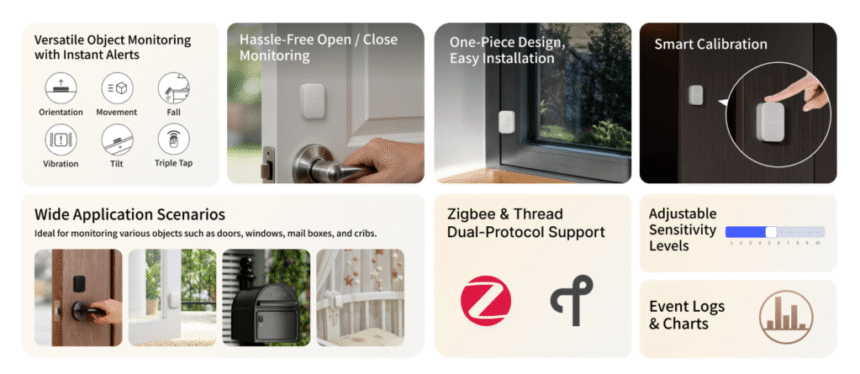
Aqara has released the Multi-State Sensor P100, a compact smart home sensor that takes a noticeably different approach from the typical door and window sensors the company is known for. Rather than relying on the usual two-piece magnet-and-body design, the P100 integrates a nine-axis sensor array into a single unit and uses AI algorithms to interpret a range of physical states. The result is a device that can function as a door and window sensor, a vibration and tilt detector, and a movement monitor, all from one piece of hardware. It supports both Zigbee and Matter over Thread, and is compatible with Apple Home, Google Home, and Amazon Alexa.
A single-body design that ditches the magnet

The most significant change with the P100 compared to conventional Aqara sensors is the elimination of the second piece. Traditional contact sensors require a sensor body and a separate magnet to be mounted in close alignment. If they fall out of alignment, the sensor stops working reliably. The P100 removes that dependency entirely by using a three-axis accelerometer, gyroscope, and geomagnetic sensor within one compact housing.
For door and window monitoring, the device uses its internal geomagnetic sensor to detect rotation angles as the door or window is opened or closed. This simplifies installation considerably and removes the need to precisely position a magnet. It also opens up the possibility of mounting the sensor in spots where placing two separate pieces would be awkward.
That said, the design is not without limitations. Aqara is upfront that the P100 is not well suited to sliding doors, garage doors, or pull drawers. The sensor depends on a pivoting or rotating motion to register an open state, so any fixture that slides or moves on a linear track will not work correctly in door and window mode.
Two operating modes

The P100 can be configured in one of two modes, depending on how you intend to use it.
Door and window monitoring
In this mode the sensor focuses on detecting whether a rotating fixture is open or closed. It reports state changes in the same way a traditional contact sensor would, making it straightforward to use in automations such as turning a light on when a door opens or sending an alert when a window has been left open.
Valuables protection
The second mode shifts the focus away from door and window tracking entirely. Here the sensor monitors for movement, tilting, dropping, and vibration, making it suited to placing on objects you want to keep an eye on rather than doors or windows. Practical examples include a medicine cabinet, a jewellery box, a laptop bag, or a tool chest.
Aqara also positions this mode as a privacy-conscious alternative to indoor cameras for light monitoring tasks. Rather than pointing a camera at a pet feeding area or checking whether an elderly family member has been active, the P100 can detect whether an object has been picked up or disturbed without capturing any video footage.
Example usage scenarios
The combination of modes and the absence of a magnet gives the P100 more flexibility than most contact sensors. Below are some of the more practical ways the device could be deployed.
- Front door monitoring: mounted on a front door, the sensor detects when the door is opened and can trigger an entry announcement, turn on hallway lighting, or disarm a security mode.
- Cabinet tamper detection: placed on a medicine cabinet or storage box, valuables protection mode can send an alert if the cabinet is opened or the box is moved, without needing a camera in a private space.
- Activity monitoring without video: attaching the sensor to a kettle, a pill dispenser, or a cupboard door allows for non-intrusive activity checks for older relatives living independently, triggering an alert if an expected action has not occurred by a certain time.
- Custom gesture control: knocking three times on a surface with the sensor attached can trigger a specific automation, such as toggling a group of lights or activating a scene, without needing a dedicated button.
- Parcel box or post box: attached to a post box lid, the sensor can notify you when the lid has been opened, indicating a delivery has arrived, in situations where a magnet-based sensor would be difficult to mount.
Self-calibration and sensitivity controls
The P100 includes self-learning calibration, which allows it to adjust its baseline readings over time and reduce false alerts caused by minor vibrations or environmental factors. Users can also choose from ten adjustable sensitivity levels, giving some control over how responsive the sensor is to movement or vibration. This is particularly relevant in the valuables protection mode, where the right sensitivity setting will depend on where the sensor is placed and what it is monitoring.
The Aqara Home app provides a visual event log, so users can review when and how an object was disturbed rather than just receiving a binary alert. This is a more useful format for reviewing activity over time.
Connectivity: Zigbee and Matter over Thread
The P100 supports two wireless protocols, and the choice between them has a meaningful effect on what the sensor can do.
Matter over Thread
When connected via Thread and exposed through the Matter standard, the P100 works with Apple Home, Google Home, Amazon Alexa, and other Matter-compatible platforms without requiring an Aqara hub. Thread provides low-power mesh networking and generally offers good responsiveness for automations. However, there is a significant caveat: in this mode, the sensor currently only functions as a basic contact sensor. Advanced capabilities, including the valuables protection mode, vibration tracking, and custom sensitivity settings, are not accessible through Thread or Matter. The sensor presents as a binary open/closed device, which reflects the current constraints of the Matter specification rather than anything specific to the P100.
Zigbee via Aqara hub
Connecting the P100 via Zigbee to a compatible Aqara hub and using it within the Aqara Home app unlocks the full feature set, including both operating modes, the event log, and the sensitivity controls. Aqara claims the CR2032 battery will last up to two years in Zigbee mode. Users who already have Aqara hubs such as the M2, M3, or M200 will be able to take full advantage of the hardware. The Aqara hub can then expose the sensor to third-party platforms via Matter bridging if required.
This split between what is available in Zigbee mode versus Matter over Thread is a recurring issue across Aqara’s more capable sensors, and the P100 is no different. If your primary smart home platform is Apple Home or Google Home and you do not have an Aqara hub, you will get a working sensor but not the full experience the hardware is capable of delivering.
Platform compatibility
The P100 is certified for Matter and compatible with the following platforms:
- Apple Home (via Matter over Thread)
- Google Home (via Matter over Thread)
- Amazon Alexa (via Matter over Thread)
- Aqara Home (via Zigbee, with full feature access)
- Home Assistant and other Matter controllers (via Thread or Matter bridge)
It is worth noting that Home Assistant users who want to use the advanced features will still need a compatible Aqara hub to connect over Zigbee. Home Assistant’s own Zigbee integration may offer some of the sensor’s data streams depending on how well the P100 is supported at the driver level, though this will need testing once the device is more widely available.
Availability and pricing
The Aqara Multi-State Sensor P100 is available in two colour options: dark grey and white. It launched initially in China at 209 yuan, before becoming available in US and EU markets from mid-March 2026. The device is currently listed on Aqara’s US online store at $29.99, with Amazon availability expected from 12th May 2026. UK and European pricing has not been officially confirmed at the time of writing, though given Aqara’s typical pricing structure for the EU market a figure in the region of PS25-PS30 would not be unexpected. The device is sold as a single unit.
Summary
The Aqara Multi-State Sensor P100 is a more capable piece of hardware than most single contact sensors on the market, and the elimination of the magnet piece makes it genuinely easier to install in a wider range of locations. The valuables protection mode and the gesture trigger functionality add depth that a standard door sensor simply does not have.
The main limitation to be aware of is the split between what works over Matter and what requires the Aqara ecosystem. If you want the full functionality, you need an Aqara hub and the Aqara Home app. Users who want to keep everything within Apple Home or Google Home and avoid adding a hub will get a sensor that works, but only as a basic open/closed contact device. Whether that is acceptable depends on what you are trying to do with it. For Aqara hub owners, or those willing to add one, the P100 looks like a practical and reasonably priced addition to a Zigbee-based setup.