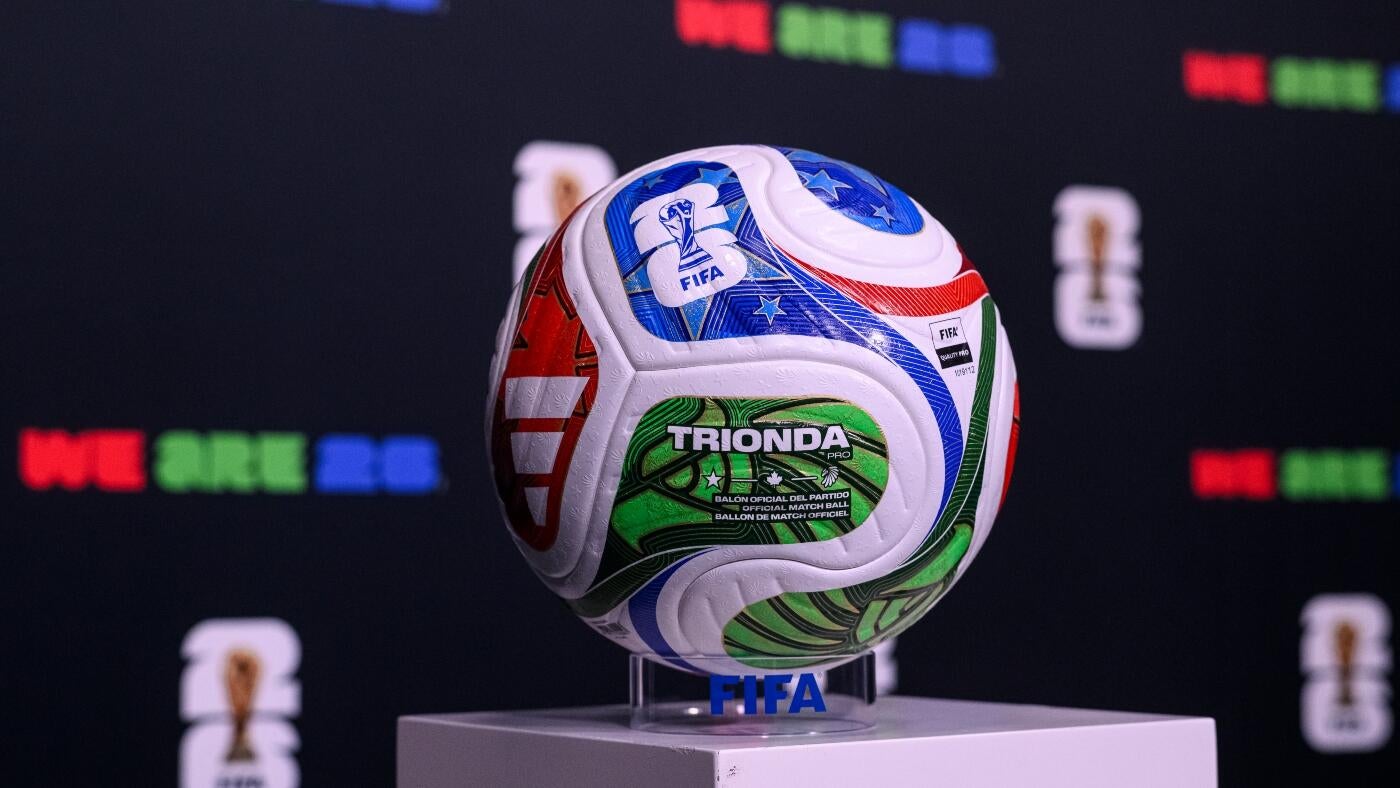
In idea, a ball is probably the most procedural facet of the World Cup, arguably the one best reminder that irrespective of how grandiose the world’s hottest sporting occasion will be, soccer’s trademark is its inherent simplicity. The game’s status is rooted in the truth that, in idea, all a bunch of individuals wants is a single, spherical piece of apparatus to get pleasure from a kickabout. Not all soccer balls are created equal, although, and that’s very true for World Cup balls.
Enter the Trionda, Adidas’ official match ball for the 2026 World Cup co-hosted by the U.S., Canada and Mexico. Like earlier World Cup balls, it appears to be like the half, the title and design are a mirrored image of the area that can host the 48-team match. “Tri” stands for the three host nations, represented by three colours – blue for the U.S., pink for Canada and inexperienced for Mexico – whereas its curved sample is a nod to “onda,” the Spanish phrase for wave or vibe. The Trionda’s most original points, although, lie within the invisible parts and its years-long journey to the ball’s unveiling on Thursday at Brooklyn Bridge Park.
“The World Cups are all distinctive so the balls are additionally very distinctive every time.,” Solene Stormann, Adidas’ international class director of soccer {hardware} stated in an interview with CBS Sports activities.
Whereas Adidas has some tried-and-true processes in bringing an official match ball to life, the Trionda went via a number of rounds of innovation and testing earlier than it was the completed product. In the long run, the Trionda is a uniquely customized product, one Adidas and FIFA will hope will keep as invisible as the small print that went into its creation by the point the primary ball is kicked for the opening sport at Mexico Metropolis’s Estadio Azteca on June 11.
Humidity, AI chip considered
The Trionda is the primary official match ball to be designed with a selected local weather in thoughts – or to be extra particular, a number of climates. The 2026 World Cup will happen throughout 16 host cities as far north as Vancouver, Canada and as far south as Mexico Metropolis, every with their very own distinct climate patterns in June and July. Adidas took all of that into consideration when designing the Trionda, giving the ball a texture with an additional grip to make sure it feels the identical on the gamers’ ft no matter venue.
“We all know that we have now 16 host cities and we needed to make sure that this ball works all over the place so we needed to test on what are the variations by way of the areas,” Stormann stated. “We all know they’ve completely different humidity ranges, completely different altitude ranges, completely different temperature, completely different climate so we needed to check in opposition to these standards and ensure this ball works.”
Adidas first examined the Trionda’s capability to carry out at completely different humidity ranges in a managed house earlier than taking it on the street to seven of the 16 World Cup host cities. There, gamers from the likes of MLS’ Vancouver Whitecaps and Liga MX’s Tigres bought to strive the product themselves as a part of the model’s testing course of.
Like its predecessor Al Rihla, the official match ball for the 2022 World Cup in Qatar, the Trionda may also have a chip powered by AI, although just a few parts are completely different. The chip will now be lodged within the facet of the ball quite than its extra central placement 4 years earlier, its Ai-powered system designed to offer a number of real-time insights and knowledge for the longer term. The expectation is that the system will permit referees to make extra correct – and sooner – choices, whereas the takeaways from the 2026 World Cup will assist inform Adidas on their subsequent improvements. The sport’s tactical evolution through the years makes earlier match balls really feel old-fashioned on the ft of modern-day professionals, so Adidas pays simply as a lot consideration to these statistics as coaches and analysts as they put together for what’s subsequent.
“In the event you take a look at sure [key performance indicators] in soccer – the quantity of passes, the quantity of high-speed operating, the quantity of sprints all through the sport, all this stuff are growing,” Hannes Schaefke, Adidas’ soccer innovation lead, stated. “From a technological perspective, in efficiency monitoring, the ball was type of the final frontier as a result of it was tremendous exhausting to trace this from an optical standpoint, nearly unimaginable. Some issues like contact frequency throughout a dribble, you [could] by no means observe that with no sensor inside so that is the place I feel, from an understanding of the sport, the depth of how properly you perceive it and anticipate the way forward for it, is the place having all monitoring unlocked is a big, enormous promise for the longer term.”
‘Essentially the most examined ball we have ever had’
To a point, Adidas has a clean canvas when designing official match balls as a result of the variables are continuously altering, refreshing the necessity for a number of rounds of testing time and time once more.
These trials have turn into particularly noteworthy since 2010, when the Jabulani utilized in South Africa was described as a “disaster” and resembled “a beach ball” by goalkeepers who took half within the competitors. That ball, in addition to the Telstar 18 utilized in Russia throughout the 2018 World Cup, obtained complaints for being exhausting to regulate, the trajectory of the ball turning into unpredictable within the course of. It’s no surprise, then, that a number of design parts are earmarked for efficiency. The Trionda, for example, is stitched collectively from 4 fluid panels whereas Al Rihla was comprised of 20 geometric panels, a change that performs a a lot greater function than aesthetics.
“We additionally see that the panel form in addition to the completely different groove strains that we utilized onto the outer shell … has an affect on the aerodynamics,” Stormann stated. ” it is not concerning the quantity of panels that dictate if it is performing properly or not, it is extra concerning the mixture of the panel with its seam size and the debossing strains, how they’re truly assorted across the ball, how they’re homogeneously positioned in order that has truly [an] affect on all of the aerodynamic standards.”
The complaints concerning the Jabulani and the Telstar 18 solely make the aerodynamics extra vital, so it is no surprise why a lot of the testing course of is devoted to that facet of efficiency.
“At Adidas, in-house, we have now our personal lab the place we do, for example, robo-like testing however we additionally work with exterior companions just like the Loughborough College. They do wind-tunnel exams so that is all very scientific however right here, we are able to already test in opposition to these aerodynamic standards like in-flight stability, the launch pace, the in-flight pace, the swerve, precision.”
From there, the ball faces its most important check – the gamers.
“We additionally wish to validate it via the gamers as a result of additionally they have a perceived manner of seeing if it performs for them or not so we additionally go on the market and check this with beginner gamers [up] till professional gamers to additionally get their suggestions and validation,” Stormann stated.
The last word trials, although, will come within the weeks and months earlier than the World Cup. Some competitions can have entry to the Trionda pretty early relying on the character of their contracts, whereas nationwide groups competing on the World Cup can have the prospect to work with the ball – at the least throughout coaching periods – three to 4 months earlier than subsequent summer time’s match. Time will inform which of its predecessors the Trionda will observe – those that turned the story or those that really represented soccer’s inherent simplicity, serving as a vital however silent participant within the present.