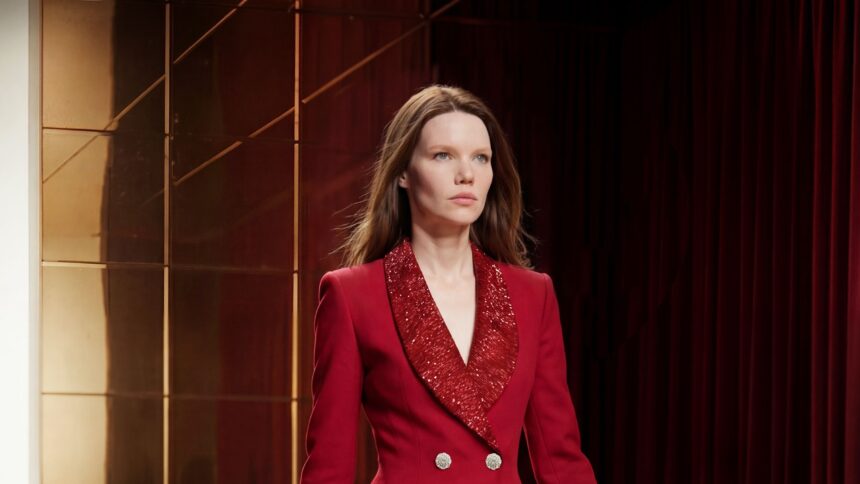
All images were generated by Alexis Mabille using AI
Question: How long did it take you to realize that no part of these images is real?
Not the dresses; not the models; neither the audience in the shadows; nor the gleaming runway. The show we attended was real insofar as we arrived at the lobby of the Lido theater on the Champs-Elysées, sat on benches, faced a wall-to-wall screen and watched something that was strange and unnatural but also pioneering and audacious.
But today, Alexis Mabille went where no fashion week designer has gone before: both his collection and show video were entirely generated by artificial intelligence.
His hyper-realist experiment brought us straight to the heart of the uncanny valley. Was it preposterous for a couturier to attempt this during the haute couture week? Purists would say oui. These looks were designed as drawings, and although they involved toile prototypes and scans of fabrics and embroideries, they do not exist as completed physical creations. Conversely, haute couture is often compared to a laboratory, and Mabille worked with several platforms over some five months to ensure a coral caftan behaved like crepe or that a model’s wavy hair swished just so.
“It was like creating a moodboard for each garment and feeding it all the way through so that, in the end, it obeys. And really, it’s about taking AI against the grain, and showing that the human element is absolutely essential behind it. You see beautiful images, you see the girls walking, and so on,” he said. “It’s about showing that, without us, without our ideas, without the hands of the technicians doing the calculations—sometimes going through a silhouette up to 300 times to arrive at the image, and then feeding the algorithms—nothing much happens. Or at least, nothing other than degenerative things.”
Mabille explained how the catalyst was wanting to help clients better visualize samples and silhouettes. He searched for engineers through 42, the computer science school founded by Xavier Niel, who then recommended AI specialists across Europe, including a production company called Gloria, capable of producing designs that his atelier would have made by hand.
Perhaps because AI feels anathema to the handwork of haute couture (a term which refers to the highest form of sewing), it was not spelled out explicitly in the show notes. Instead, Mabille said he chose to “engage with technological innovation” using “new tools [that] opened the way to unexplored creative territories.” Anthropomorphizing the complex coding, he said backstage, “It’s really like having someone on the team who’s a bit of a beginner, who’s done a long internship, and then becomes part of the team.”
What about the other teams—casting, hair and makeup artists, manicurists, dressers et all—no longer participating? Didn’t Mabille miss the energy, the backstage cheers at the end? “It’s different. I’m not sewing a hem at 3am. Even the atelier staff found it strange,” he said. Was it more cost effective, at least? “It’s not that economical,” he said. “It’s hours of highly skilled labor.”
The IRL mastery on display at other maisons this week is the best bulwark against more of this. Likewise that elusive frisson that occurs from a live moment. Here, the music selection included “Vous êtes parfait.e.s” (You are perfect) by Lucie Anthunes. Give me shoddy tailoring and waifs wobbling in heels any day over the slick perfection of this alternate world, its front row comprising a sea of unrecognizable faces.
The final bridal look was modeled by Mabille’s mother—well, a virtual, glowed-up version of her—in froths of frayed organza. Then Mabille walked out in the flesh, and the energy felt weird as people seemed to be processing what they had just witnessed. Whether his AI runway becomes a case study at fashion schools, sends a ripple across industry, or yields an uptick in his client orders, he got our attention by crossing the rubicon. For better or worse, he won’t be the last.