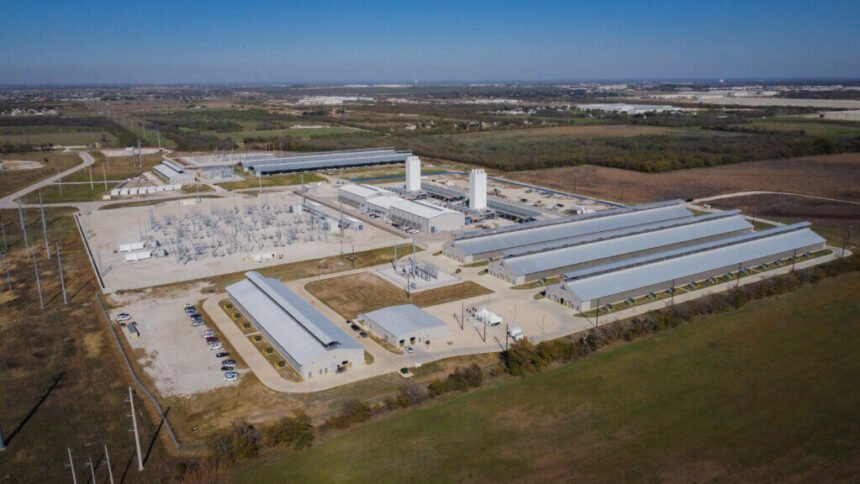
Core Scientific (NASDAQ: CORZ) said Wednesday it plans to expand its Muskogee, Oklahoma campus to 1.5 gigawatts of gross power, or about 1.0 GW of leasable capacity. The expansion would make it the bitcoin miner’s second site at that scale as the company expands AI/HPC infrastructure.
Shares of CORZ rose 7% in pre-trading hours, up to $23.79 per Yahoo Finance.
Core Scientific first announced the Muskogee campus in November 2024, when Core Scientific, CoreWeave, and Port Muskogee broke ground on a 100 MW data center designed to host NVIDIA GPUs for an undisclosed client. That initial phase included roughly 70 MW of critical IT load, with the remaining 30 MW supporting ancillary systems. The facility was part of a broader 500 MW of critical IT load that CoreWeave contracted from Core Scientific, with a potential value of $8.7 billion over 12 years plus two five-year options.
At the 2024 groundbreaking, CEO Adam Sullivan said the project highlighted Muskogee’s role as a center of “next-generation, AI computing.” Port Muskogee projected the facility would bring more than $4 billion in capital investment, $182 million in local net benefits, and 150 jobs with average salaries exceeding $65,000 over the life of the project.
Core Scientific announced on April 27 that it planned to scale its Pecos, Texas campus to 1.5 GW of gross power as well. That site was already being converted from bitcoin mining toward AI infrastructure, with the first data hall reaching a construction milestone. The company said it had secured an additional 300 MW of gross power under contract with its utility provider and more than 200 acres of land at the Texas site.
The Muskogee plan also includes converting existing bitcoin mining capacity, adding contracted utility power, and securing land for future buildout.
To fund the expansion across multiple states, the company announced plans in April to raise $3.3 billion through senior secured notes due 2031. It also secured a $1 billion loan from Morgan Stanley in March, which it likely paid off using the secured senior notes.
Oklahoma lawmakers have been advancing House Bill 2992, which would require utilities to ensure residential and commercial customers are protected from rate increases tied to large-load data center customers.