The future of getting to the airport just took off over Manhattan. And Florida and Texas are next.
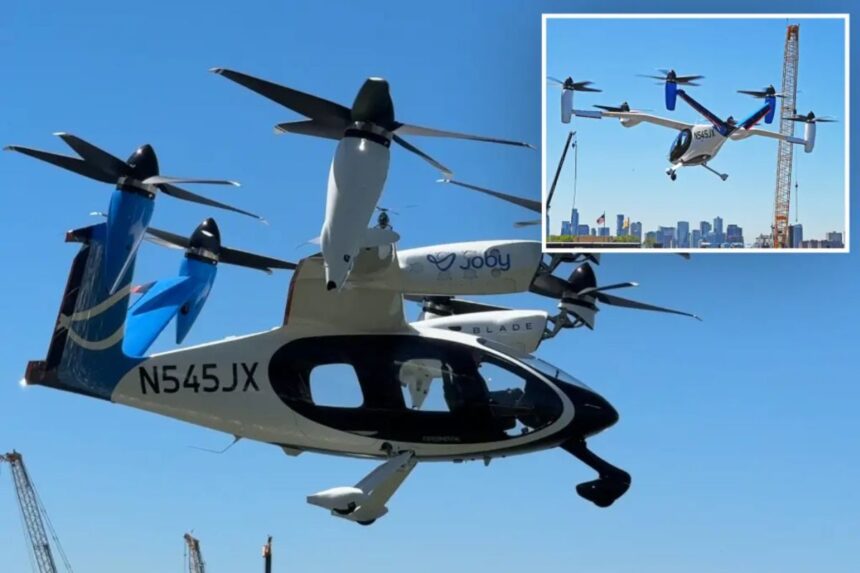
On Monday, Joby Aviation completed its first-ever demonstration flights between JFK Airport and midtown Manhattan — a journey that took under ten minutes in a near-silent, all-electric aircraft that seats four passengers plus a pilot. The flights, conducted under the White House-backed eVTOL Integration Pilot Program (eIPP), mark the most concrete step yet toward commercial air taxi service in the United States.
What Is the Joby Air Taxi and How Does It Work?
Joby’s S4 aircraft looks like a cross between a drone and a small plane. It takes off vertically like a helicopter, tilts its six rotors forward, and cruises at speeds of up to 200 mph. It produces virtually zero noise at cruising altitude — a characteristic that Joby’s chief product officer Eric Allison demonstrated live on Monday by leaving the lounge door open as the aircraft landed. “If you left the door open when a helicopter landed, no one’s happy in the lounge,” Allison said.
The aircraft has now logged over 50,000 miles of test flights across five countries, and in March 2026, Joby became the first eVTOL company to complete Stage 4 of the FAA’s five-stage type certification process — leaving just one formal review gate between its aircraft and paying passengers.
Florida, Texas and New York Are the Priority Markets
Under the White House eIPP program, Joby has been selected to begin early operations in ten U.S. states before full FAA certification — with Florida, Texas and New York among the highest priorities.
In Texas, Joby will develop air taxi networks connecting Dallas, Austin, San Antonio and eventually Houston. In Florida, a three-phase program will cover cargo delivery, passenger transportation and medical response operations across the state. In New York, the Port Authority is collaborating on routes connecting JFK and Manhattan — the same corridor demonstrated this week.
Joby is targeting a late 2026 commercial launch in partnership with Delta Air Lines, which has invested up to $200 million in the company. Initial fares are expected to run between $150 and $300 per trip — comparable to premium helicopter services today.
What Still Has to Happen
Despite the momentum, hurdles remain. Stage 5 FAA certification — the final step — has no guaranteed timeline. Independent aviation analyst Robert Mann noted that infrastructure is equally critical. “The aircraft getting certified is necessary but not sufficient,” Mann said. “You need somewhere to land. Right now, the pipeline of permitted, purpose-built vertiports in U.S. cities is very thin.”
Dallas, Miami and Los Angeles have approved feasibility studies for vertiport sites, but none has issued a construction permit as of April 2026.
For now, Joby’s Manhattan flights this week offered the most tangible preview yet of what American air travel could look like before the decade ends — and Florida and Texas won’t be far behind.
Sources: Joby Aviation press release, April 27, 2026 · Aircraft Insider, “Joby Aviation Clears FAA Stage 4 Certification,” March 2026