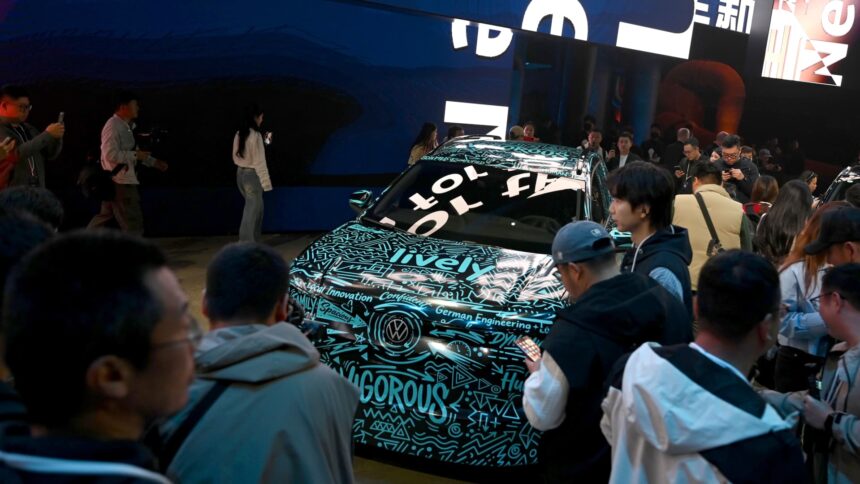
Volkswagen shows off a prototype of its ID.Aura T6 in Beijing, China, in April 2026.
Picture Alliance | Picture Alliance | Getty Images
German auto giant Volkswagen announced it’s incorporating AI voice commands into its cars for the Chinese market.
Starting in the second half of this year, all vehicles based on Volkswagen’s China car system will feature AI agents that allow humans to control car features with voice commands, the company said on Tuesday.
“The car should be like a companion,” Volkswagen China CTO Thomas Ulbrich told CNBC’s Eunice Yoon.
He said the company’s in-car AI agent would draw on tech from Tencent, Alibaba and Baidu, among others, to create a tool with “personality” that can anticipate a driver’s needs.
The AI uses a locally trained large language model and runs entirely on the car, rather than the cloud.
Volkswagen revealed four cars in Beijing on Tuesday, including the ID. UNYX 09, which the company claimed it co-developed with EV maker Xpeng in two years.
The move is part of the company’s strategy to recoup lost market share as China has rapidly turned to electric cars from ones powered by internal combustion engines.
Over the last few years, Volkswagen has invested heavily in China, with stakes in Xpeng and automotive chipmaker Horizon Robotics.
With those partnerships, the German automaker is not using Nvidia chips in its cars in China. Instead, Volkswagen is using Xpeng’s Turing chip in an electric SUV set to begin deliveries by the end of June, while an advanced automotive chip project with Horizon Robotics remains under development.
Volkswagen also announced Tuesday that, starting next year, it will use agentic AI to power a unified driver-assist and cockpit control system.
In November, the German automaker announced its research center in Hefei could independently develop and approve technology for its Chinese cars, reducing the time to market.
Over the last two years, German automotive industry companies in China have significantly increased their research and development activities in the country, with the aim of serving both the local and global market, according to a report released Tuesday by the German Chamber of Commerce in China.
Nearly 80% of automotive companies surveyed by the chamber said that localizing R&D in China has lowered those costs versus Germany over the last two years, while about 43% of respondents said their innovation speed has increased by more than 40%, the report said.