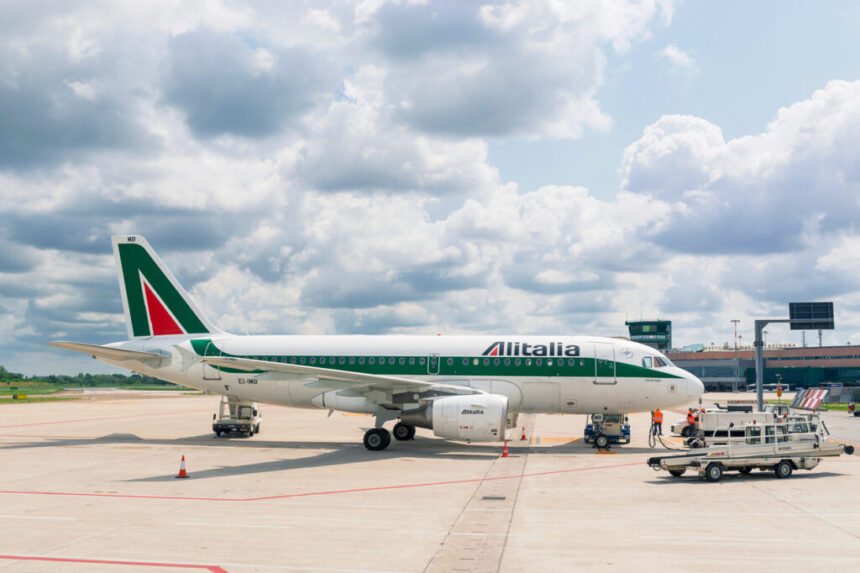
Seven Italian airports are now operating under emergency jet fuel rationing — the most visible sign yet that the conflict in the Middle East is landing squarely on European travelers.
Air BP Italia has issued emergency notices restricting refueling at Bologna, Milan Linate, Venice Marco Polo, Treviso, Brindisi, Pescara, and Reggio Calabria, with caps as low as 2,000 litres per aircraft for non-priority short-haul flights.
The restrictions are formal. According to Air BP Italia — the British Petroleum group’s specialized aviation division — the measures aim to preserve remaining reserves for essential services, with priority given to ambulance flights, state flights, and routes longer than three hours. Everyone else gets whatever is left, subject to a hard ceiling.
Why 2,000 litres barely gets you off the ground
The cap sounds manageable. It isn’t. Technical calculations provided by pilots to Il Corriere della Sera confirm that 2,000 litres gives a Boeing 737 or Airbus A320 less than one hour of flight autonomy — not enough to complete a direct domestic route, such as one connecting Veneto to Sicily, without stopping to refuel elsewhere.
Airlines are therefore forced to add technical stops — often at fuel-rich hubs such as Rome Fiumicino or Zurich — or to swap aircraft, lengthening itineraries and driving up costs.
The workaround has a name in the industry: “tankering,” where planes carry extra fuel loaded at their departure airport. It works, but it adds weight, burns more fuel overall, and puts pressure on an already strained system.
How it got here
The root cause is the closure of the Strait of Hormuz following the US-Israel conflict with Iran that began February 28. The Strait carries approximately 20% of global oil, and its effective shutdown has forced tankers to reroute around the Cape of Good Hope — adding 10 to 14 days to delivery schedules.
Northern Italian fuel depots, already stretched over the busy Easter weekend, drew down their strategic reserves faster than anticipated.
Brindisi, Pescara, and Reggio Calabria joined the rationing list on April 6, following disruptions that began two days earlier at the northern airports. The crisis, in other words, is moving south.
What comes next
Italy may be the first, but it likely won’t be the last. Ryanair CEO Michael O’Leary has warned of broader European disruptions, predicting flight cancellations of 5 to 10 percent across the continent if the Strait of Hormuz remains closed through summer.
For now, travelers flying into or through Milan Linate, Bologna, Venice, Treviso, Brindisi, Pescara, or Reggio Calabria should expect potential delays, unscheduled fuel stops, and last-minute schedule changes. Booking through Milan Malpensa or Rome Fiumicino — currently unaffected by rationing — is the most reliable way to avoid disruption.
The era of plentiful, cheap jet fuel may be temporarily over. Italian airports are feeling it first.
Sources: FTN News, Euronews, Il Corriere della Sera, VisaHQ Travel News