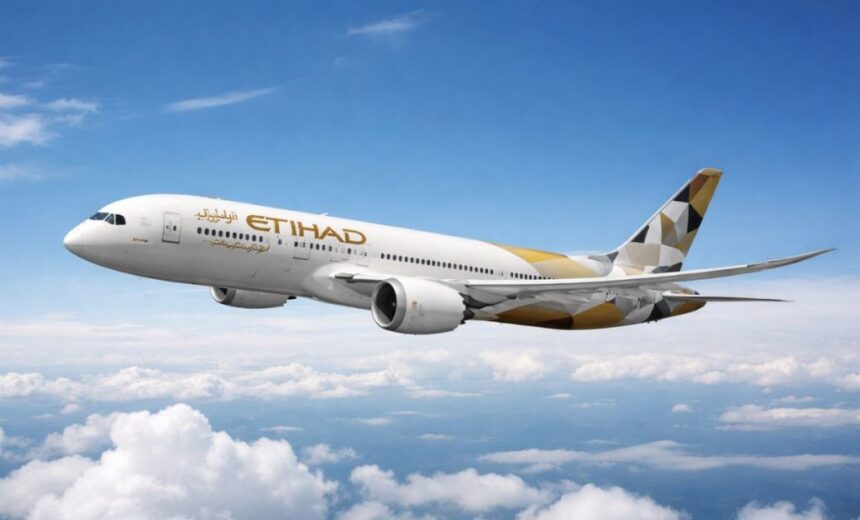
A major international airline has cut ticket prices by as much as 50% on selected long-haul routes, as carriers contend with weakening travel demand linked to geopolitical tensions in the Middle East.
The move is widely viewed as a short-term strategy aimed at stimulating bookings and maintaining passenger confidence during a period of heightened uncertainty for the global aviation industry.
Etihad Airways has implemented the reductions across several key routes in an effort to sustain demand.
Sharp Fare Reductions Across Key Routes
The Abu Dhabi-based carrier, Etihad Airways, has introduced significant discounts on flights originating outside its main hub, particularly for travel scheduled between April and June 2026.
According to fare data published on the airline’s booking platform and reported by The National, several long-haul routes are seeing substantial price drops:
- London Heathrow to Tokyo Narita fares are currently around $910, rising to between $1,250 and $1,875 during the peak summer months.
- Bangkok to Paris tickets are priced at approximately $670, with fares expected to increase significantly later in the summer travel season.
- Hong Kong to Barcelona fares start at about $590, before climbing to as much as $1,190.
- These conversions are indicative and may vary slightly depending on real-time exchange rate fluctuations and booking conditions.
Prices are notably lower for spring travel but surge as demand rebounds heading into July and August, reflecting typical seasonal patterns compounded by current market uncertainty.
Conflict-Driven Decline in Travel Demand
The fare cuts come amid a broader slowdown in travel to and from the Middle East, driven by ongoing geopolitical tensions, particularly the Iran-related conflict. Airlines across the Gulf region have reported reduced passenger volumes and operational disruptions, including altered flight paths and constrained airspace.
This drop in demand has forced carriers to rethink pricing strategies, with aggressive discounts emerging as a key tool to fill seats and sustain revenue streams.
While Etihad has not issued an official statement on the pricing adjustments, analysts suggest the airline is responding to both declining bookings and heightened traveler uncertainty.
Industry Experts: A Short-Term Strategy

Aviation analysts caution that such deep discounts are unlikely to last. Saj Ahmad, chief analyst at Strategic Aero Research, emphasized the temporary nature of the move.
“Etihad’s move here very definitely is a short-term one,” Ahmad said. “Given the volatility in the region, coupled with limited flights and flight corridors, these sorts of low fares are simply unsustainable in the long term.”
He added that rising fuel costs and operational complexities will inevitably push fares higher once market conditions stabilize.
“This is more of an incentive to ensure people keep flying where possible and provide confidence to travelers that Etihad is operating as close to normal as is possible,” Ahmad noted.
Wider Implications for the Aviation Sector
The pricing strategy reflects broader pressures facing the global airline industry. According to recent aviation outlooks from organizations such as the International Air Transport Association (IATA), geopolitical instability and fluctuating fuel prices remain key risks to recovery.
Airlines are increasingly balancing competitive pricing with cost management, particularly as they attempt to rebuild international travel demand following years of pandemic-related disruption.
Notably, fares on routes departing directly from Abu Dhabi appear largely unchanged, suggesting that Etihad is selectively targeting markets where demand softness is most pronounced.
Outlook: Temporary Relief for Travelers
For travelers, the current window offers an opportunity to secure lower fares on long-haul routes. However, industry consensus indicates that these discounts are unlikely to persist.
If geopolitical tensions ease and demand rebounds, ticket prices are expected to return to higher, more sustainable levels, particularly during peak travel seasons.
In the meantime, Etihad’s aggressive pricing underscores the fragile state of global travel demand—and the lengths airlines are willing to go to keep passengers flying.