“What’s called ‘Chinese style’ is a huge world. It’s impossible to summarize, because it’s about the history… and also the modern day of people living in the street, the color and the humor. That’s a lot of things to pick up. And I feel that’s why we don’t feel like being limited… to only pay attention to a certain culture, because nowadays, everything’s so fluid and mixed.”
Samuel Gui Yang was speaking alongside his co-founder and co-designer Erik Litzen. The show just finished demonstrated the breadth of a design dialect refined for over a decade, conceived through a pronouncedly Chinese accent, and conjugated according to a contemporary European fashion grammar. The London-based 2020 LVMH Prize semi-finalists and former CSM classmates are exploring a similar liminal space to that of their fellow Shanghai Fashion Week label AO Yes, but from a different direction and distance.
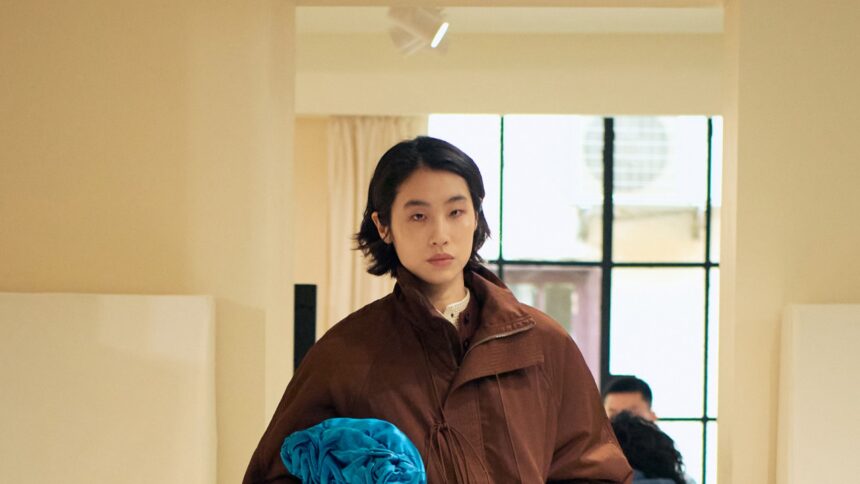
The strapped fastenings, tubular quilting, frogged buttons, collar shapes, and high double-breasted closure profiles displayed here and there across the collection all registered as Chinese. The designers then worked to blur the cultural provenance of these architectural signals by constructing them in less specifically-sited fabrics or with unorthodox design twists. Thus a double-faced qipao in silk was cut to fall from the body at the right hip and then wend to the floor like an evening gown, while a stand-collared zip-up shirt with matching full skirt was cut in washed denim.
Around these bouncing signals the designers and their stylist created further interference. A model in a frogged button quilted tabard in woody brown over a stand-collared shirt and suit in pale green wore earrings from which trailed scarlet ribbons. A fringed poncho, also scarlet, was tied with conscious rusticity by a piece of blue string. Along with a tulle and feather cloaklet worn over a raincoat, headpieces apparently made from other garments, and a square parasol with a trailing canopy of black that pretty much obscured the look, these touches added a non-specifically folkloric tint to the overall picture.
There seemed to be an underlying story of movement, of the character being in transit, relayed by the silk hip-slung packs, rolled up blankets, pouches made from Bhutanese paper, and dresses carried like accessories. Asked about the dynamic of their design process when approaching a cultural tradition in order to modernize and recontextualize, Litzen said: “We try to always approach it quite instinctively. Then, of course, you need to do some work afterwards to make sure that it doesn’t end up being something that feels too close, or which can even cross some boundaries. We want to be respectful. But we start with intuition, see where it leads us and then edit afterwards.”