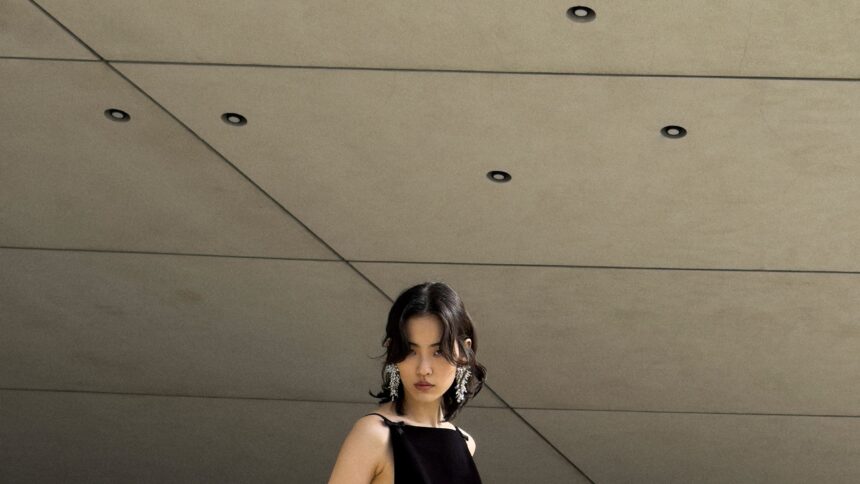
Last season, a pair of petal-domed earrings proved such a hit that Han Chong recast them as buttons on a red-and-turquoise bouclé jacket for fall. It’s the sort of piece you can imagine a fashion editor unearthing on resale, then throwing over a band tee and micro-shorts for a night out. There’s a real trend for this kind of styling at the moment—approaching what might once have been considered precious, or staid, with a little irreverence—as seen in all the Chanel pumps peeking out beneath ripped Levi’s across fashion month’s front rows. The best of Self-Portrait’s fall 2026 collection pivoted on that same sort of tension: pelt-lined bombers offset with denim minis; twinsets paired with zip-front vinyl pencil skirts; double-breasted blazers with twist-seam cargo pants.
“It’s a reaction to the younger generation’s idea of dressing up,” Chong said. “Where everything can be mixed, matched, and worn against type.” With over 50% of Self-Portrait’s business now coming from direct-to-consumer channels, Chong’s team has the data to track these shifts in real time. Where the focus once fell squarely on embellished dresses, for example, the past year has seen building-block basics emerge as an increasingly important category. Hence the black stirrup leggings, navy capri pants, charcoal three-quarter-zip sweaters and funnel-neck leather jackets that count as wardrobe essentials.
“I try to get as close as possible to what she wants to wear, using the data we have,” Chong said. “We review our trade reports weekly and react quickly to what our customer is asking for.” As for what’s driving that demand? “Comfort,” he added. “But it still needs to feel sexy—especially going into winter.” There was a looseness in both spirit and fabrication to a taffeta bubble top with linen shorts, a ruched long-sleeve paired with silk pants, and a fringed silk blouse over an A-line leather skirt.
And yet, despite Chong’s emphasis on ease, a large part of the collection was devoted to flashy eveningwear: power-shouldered gowns in cherry-red and emerald jersey; asymmetrically draped tops and mini skirts hot-fixed with horizontal diamanté; neon-green satin shifts with ankle-length trains. Elsewhere, long-sleeved pointelle dresses were suspended from thick crystal collars; ivory appliqué-and-sequin bridal columns were hemmed with feathery blooms; and, in another nod to clashing sartorial registers against each other, a black and boudoir-ish lace corset dress came complete with a pleated taffeta maxi skirt. “Compared to what I used to do, it’s much more pared back. It’s about putting in almost minimal effort and still looking put together,” Chong said—the logic being that a dress, however ornate, requires nothing more than stepping into it. “Clothes should be as easy as possible.”