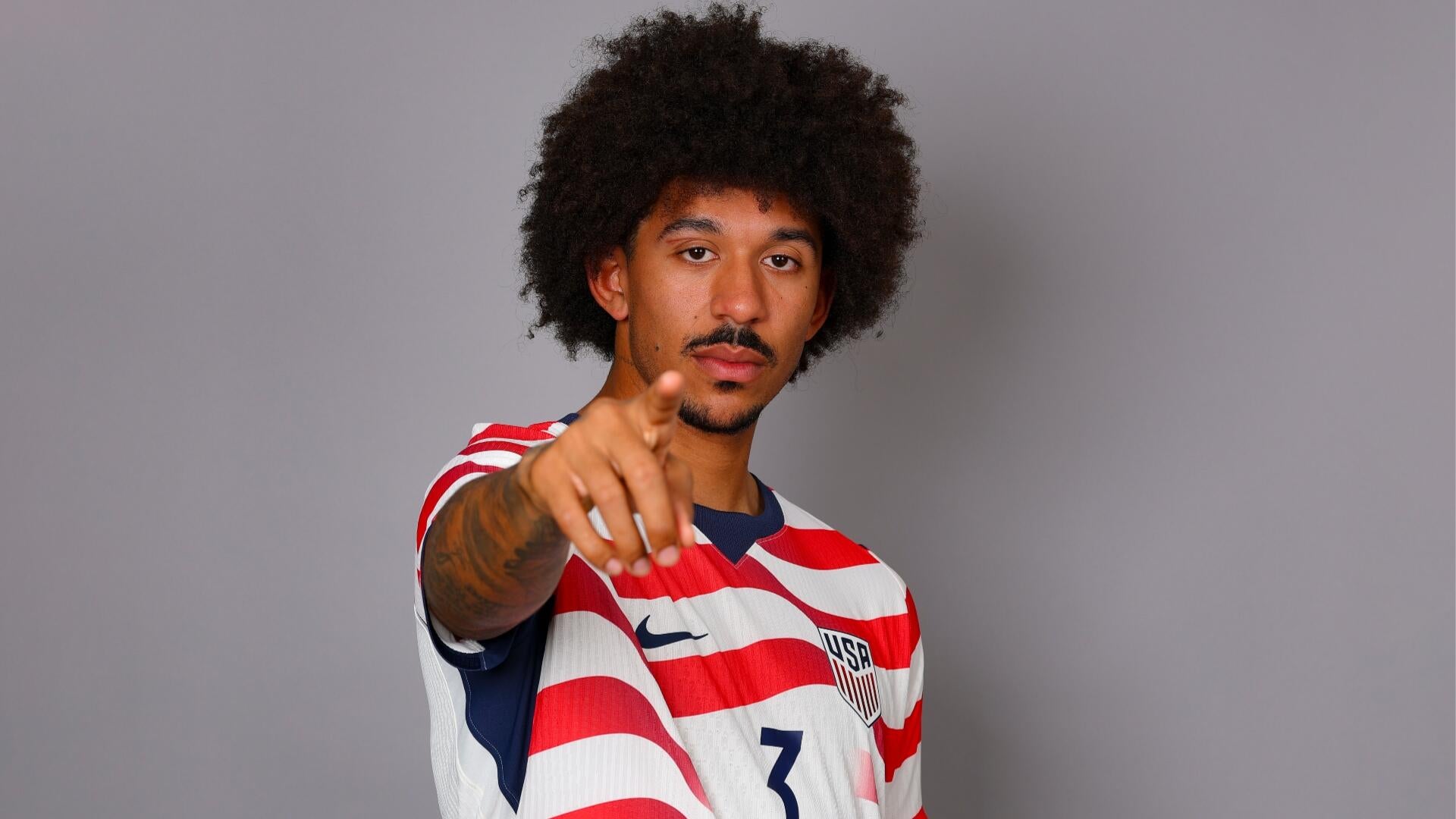
For most modern-day soccer players, one day off was a treat but Chris Richards had the unique gift of multiple days of rest in early March, with which he did very little. He took a walk in a park near his south London home, listened on as his 15-month-old daughter was glued to “Ms. Rachel” and after the toddler went to bed, he caught up on the TV show “Fallout.” He laid low on purpose – he was in the midst of the busiest season of his career as Crystal Palace balanced a domestic load with competition in the UEFA Conference League. With three months to go until the World Cup, it was only going to get more intense from here.
“I’d be lying if I said I didn’t think about it all the time,” Richards told CBS Sports earlier this month. “I try to compartmentalize especially being at Palace, you still have a lot to play for the season. I’m trying my best to take it day by day, but again, I want to make sure that I do everything possible to be there at the World Cup.”
Few, if any, members of the U.S. men’s national team are acting like locks for Mauricio Pochettino’s World Cup roster but Richards is as close as it gets to a guarantee. The 25-year-old has become a regular fixture at Palace, paving the way for him to emerge as one of the USMNT’s starters at center back. His rise was steady, his journey to becoming a reliable national team player almost mundane as he turned a stint in an MLS academy to a one-way ticket to Europe. His journey from Birmingham, Ala. to London, by way of Houston, Dallas, Munich and Sinsheim, Germany, was not exactly conventional, though.
“I shouldn’t be here, if I’m being honest with you,” he quipped.
Richards was cut from a trial at FC Dallas, landing instead at a youth club in Houston before the MLS club’s academy came calling. Within two years of leaving Birmingham, he was on Bayern Munich’s books, only to be relegated to the reserve team or sent on two separate loans to Hoffenheim. He was not an immediate starter at Palace, either, and first broke into the team as a defensive midfielder rather than his preferred center back role. Everything’s coming up Richards, though, and not a moment too soon as a World Cup on home soil nears.
“I never wanted to be just a name on the teamsheet,” he said. “I wanted to be one of the first ones in it.”
Chris Richards, brick wall
Richards is a natural fit for Pochettino’s version of the USMNT in more ways than one, perhaps primarily from a tactical sense. Pochettino’s switch to a back three last September has paid dividends, the team so far unbeaten since the formation change five games ago. Richards, already a national team regular at that point, adapted quickly – he played in a back three frequently for Oliver Glasner’s Palace, a perfect anchor as the USMNT began to put a year’s worth of poor results behind them. As long as Richards and his colleagues in the back do their jobs, the strategy “allows you to put more creative players on the field as well and let them do their magic.” It feels like an unglamorous trade-off but Richards insists there are perks for him, too.
“I love it,” he said. “I think even for us defenders, it’s a chance for us to be aggressive. When you’re so far off the pitch, it’s your time to smash into somebody and you win the ball up that high and then it really is a counterattack within 20 yards of goals. I really enjoy it. I really do.”
On-field aggression is a common theme for this iteration of the USMNT, a defining ethos as Pochettino attempts to reenvision the group ahead of the World Cup. Richards’ natural tendencies, then, are a perfect match for the team’s intense identity.
“I think there’s a lot of emphasis on ball-playing center backs but for me, my first role is to defend,” he said. “Of course, I want to be able to play with the ball. I feel like I do pretty well but I think being able to usually defend and kind of completely eliminate the other team’s best attacking threat, that makes me happier than anything. Now, I think to be a center defender, you have to be a little sick in the head, to be honest with you. You have to want to head the ball. You have to want to crunch people and pretty much, your job is that once you get the ball, to give to the people who go make the magic happen and so for me, like I said, my favorite thing in the world is to have like a crazy crunch tackle and everybody goes wild so I’d rather do that than score a goal. That’s my job and I love it.”
Richards has been foundational to Pochettino’s reinvention of the national team, on the ground during vital moments on their road to the World Cup. That includes last summer’s Concacaf Gold Cup, during which Pochettino began to leave his stamp on the group, even as a group of fringe players made up more numbers than established talent. The USMNT had underwhelmed for the most part since their round of 16 exit at the 2022 World Cup, a group stage exit at the 2024 Copa America and a fourth place finish in the Concacaf Nations League in March 2025 among the low points. Pochettino’s fundamentals finally began to come across on the pitch, chief among them an eagerness to win above all else.
“I think at Gold Cup was the time we were like, you know what? This is the time to bust people’s asses. This is our time to go in there, kill and show them why we deserve to be the top of Concacaf, why we’re going into this World Cup with our heads held high, going in with a lot of confidence,” he recalled. ” We want to take on anybody. If they want to bring a fight to us, we’ll do it. I remember Copa America. I remember the Panama game [which the USMNT lost 2-1] and I keep replaying everything in my head. I’m like, if we would have just set the tone earlier, that wouldn’t have happened and then who knows what would have happened throughout Copa America? For me, [the Gold Cup] was a chance to show everybody, America, that we can do more than just play pretty soccer, that we can also be enforcers while doing it.”
Pochettino’s influence has rubbed off on Richards, who has taken the coaching staff’s advice to improve his own game in meaningful ways.
“They’ve taught me a lot about the game, about reading the game, about doing your work early, about [how] half of the battle is sorting the people out in front of you,” Richards said. “I think it’s easy to think about yourself personally about what you can do but if you can make the people around you do the dirty work, it kind of makes your job a bit easier so that part is something they’ve definitely taught me and also reading the game.”
The USMNT will likely go as high as Richards can take them at this summer’s World Cup, the 25-year-old perhaps the most in-form center back in a group that relies on them heavily. Much like his upward trajectory, the weight of expectations has come at the right time in his career.
“There’s, I guess, a bit of responsibility to it,” he noted, “but it’s not something that I’m scared of.”
A leader for a new-look USMNT
The responsibilities Richards carries are heavy but not exactly burdensome, though it helps when the mood’s high. Nearly a year after winning the FA Cup with Palace, his performance against Manchester City a snapshot of his preference to eliminate the opponent’s attacking options, a community of fans in south London still gives him his flowers, only increasing his desire to perform for them.
“One thing about south London is that it’s a bunch of hardworking people but also a lot of blue collar people and so now whether I’m in a taxi, a lot of the taxi drivers are Crystal Palace fans and they’re always like, ‘Thank you for everything that you’ve done for the club,'” Richards said. “Being able to bring a club and bring a community something that they hadn’t achieved in over a hundred years, I think it’s hard to really comprehend it because I’d never seen something like that so to understand, I guess, the gravity of what we did, seeing the final whistle and seeing all the emotions from fans, from employees who have been at the club forever from people on social media, from taxi drivers, it was just. It was beautiful to see and I still see it. Even yesterday in the park, I was walking and a guy pulled me and was like, ‘Thank you for everything that you’ve done for Crystal Palace.’ For me, it felt like of course I love winning a trophy but it was so much more than winning a trophy. It was giving back to the community that had never won something so I think it was amazing. It was beautiful. It was every possible positive word you could say, that’s what it was.”
Richards said he has found a family inside the walls of Palace’s locker room, thankful that they saw him the same way when he joined the club in 2022. He has been in the practice of giving back ever since, crediting ex-Palace captain Joel Ward with keeping him grounded as he struggled for playing time during his first season in the Premier League.
“I think as a 22-year-old who came from a big club like Bayern, you’re thinking, all right, cool. I’m gonna get here. I’m gonna play,” Richards recalled. “I feel like I was doing everything right and so [Ward] pulled me to the side a few times, like, ‘Everybody sees you doing the right thing. Just keep doing the right thing so that when your time does come, you’re ready for it’ … He wasn’t even really playing at the time but he knew what his spot and what his role was in the club and he did it perfectly.”
Ward’s influence still looms large, especially as Richards slips into veteran status on the USMNT after Pochettino’s player pool expansion project since taking the helm in the fall of 2024.
“I want to continue to establish myself as a leader, kind of like what Joel Ward did for me,” Richards said. “I think understanding that maybe there’s going to be people who are going to be upset with how many minutes they play, with how training goes but I think being able to pull somebody and have this conversation with them, knowing that [they’re] having a tough time. I think it’s something that I really want to do for the team because it makes us stronger. You never know if you’re going to play 90 minutes, you’re going to come on to play two minutes, but every minute that you play is going to count, especially at a World Cup so like I said, I think making this culture, I’m making everybody feel welcome but also making everybody feel like they’re bought into this culture.”
Culture has been another USMNT buzzword since Pochettino took charge, the new coaching staff trading intense training sessions for genuine relaxation time. The players have expectedly found ways to bond with one another, in some cases going out to dinner or during the month-long Gold Cup, buying portable game consoles and gathering in rooms as a group to play against each other. Richards has not kept to himself or his longtime national team friends, either.
“During Gold Cup, I think it was me, Mark McKenzie, a few of us went to go eat dinner with Kellyn Acosta because we started off in Chicago and you were like, ‘Alex Freeman, come on. You’re coming with us,'” he said. “We didn’t really know Alex. It was one of the first few days but I think that was straight away something that set the tone because we showed him that he was included. It made him want to fight for the team because he enjoys the people beside him and not just that. At some point he’s going to be one of the older guys in the national team and he’s going to see the young kid come in and maybe he’ll remember that interaction that we had and he’ll bring one of the kids along for dinner. I think it’s just things that, I think, have been gradually passed down from older generations that we want to keep doing.”
There was space for a joke between new friends, too.
“It was a steakhouse,” he said about that evening’s culinary selection. “We told [Freeman] that he was paying for it so he started sweating a little bit. Of course, we didn’t make him pay for it but you could see how nervous he got once we said it. That was funny.”
Dining out is a staple of Richards’ routine during international breaks, the coaching staff allowing players to get things out of their system on a day off. Tastes vary, though – in October, Richards, McKenzie, Weah and Weston McKennie treated Cameron Carter-Vickers and Antonee Robinson, two USMNT players raised in England, to an American staple in Chili’s. The selection? A little bit of everything.
“The Triple Dipper you have to get but then I think it’s the endless chips and salsa, but then also there’s sports on TV and also the chocolate molten lava cake and it’s just like you’re sitting there and you’re looking at the ground, the tile,” Richards said. “You’re like, this is beautiful. This is nostalgia. This is really America … I think that’s one of the things that makes us American — places like Chili’s are like a staple and I think they finally could have that stamp on their passport now that they’ve had Chili’s so I was happy for them.”