Rivian CEO on how its Uber deal came together, and why the AI ‘driver’ is the future of mobility
Share
8 Min Read
SHARE
Last week, Rivian (RIVN) and Uber (UBER) completed a $1.25 billion deal for up to 50,000 R2 robotaxis. The two dealmakers — Rivian CEO RJ Scaringe and Uber CEO Dara Khosrowshahi — have known each other for years, and the agreement was in the works for some time.
“Transportation, mobility is a small world, so I’ve known Dara for a long time,” Scaringe told Yahoo Finance in an exclusive interview. “We’ve been talking about this deal for maybe about a year, but different versions of it, and it’s hard to define a deal of scale where there’s so many unknowns.”
Some of those unknowns include metrics like vehicle revenue per mile, essentially the revenue generated while the vehicle is being used, Scaringe said, which is of utmost importance to Rivian and ultimately determined the parameters of a deal with Uber.
“We’re very, very bullish on what’s the rate of progress that we’re going to see as an industry towards Level four [self-driving], and we saw a real opportunity to do something exciting and large with Uber,” Scaringe said. “Ultimately, what came together, I think, is one of the larger deals, if not the largest deal, that they’ve done, both in terms of the investment, but also in terms of the vehicle fleet size.”
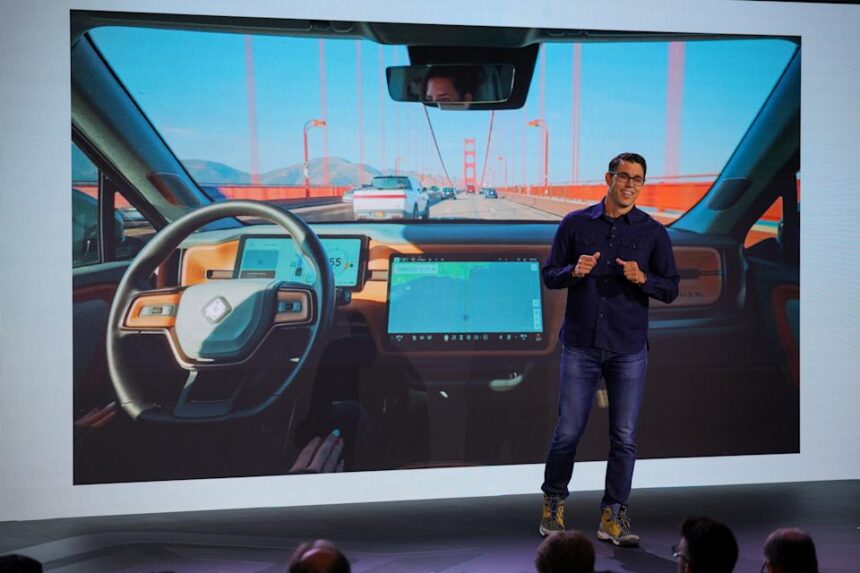
Rivian CEO RJ Scaringe speaks at the company’s first Autonomy and AI Day, showcasing developments in self-driving technology, in Palo Alto, Calif., on Dec. 11, 2025. (Reuters/Carlos Barria) ·REUTERS / Reuters
Read more: How to find the best luxury car insurance
Part and parcel of that deal is Rivian’s upcoming R2 midsize EV, one that Scaringe said fit the form factor and package Uber was looking for.
Of course, Uber has other partners, including Rivian rival Lucid (LCID), but what’s different about the Rivian partnership is that there is no third tech partner or autonomous software provider.
In this case, Rivian’s in-house Autonomy Platform, which combines the company’s self-driving software with custom hardware like its Rivian-designed chips, will power the tech.
Rivian CEO RJ Scaringe speaks as a screen displays a visualization of Rivian’s Autonomy processor, at the company’s first Autonomy and AI Day, showcasing developments in self-driving technology, in Palo Alto, Calif., on Dec. 11, 2025. (Reuters/Carlos Barria) ·REUTERS / Reuters
“There’s a lot of revenue for some of the digital or AI support services or enabling capabilities, and I think the biggest of those opportunities by far is the driver,” Scaringe said. “So, if you sell a vehicle and then you also sell a driver, the driver is quite valuable, right?” He noted that the “driver” in this case is powered by Rivian’s autonomous software.
Read more: 6 steps to find cheap car insurance in 2026
And that’s not just for robotaxis. The vast majority of cars sold are for personal use, and Rivian’s Autonomy software is key to providing enhanced value — and revenue — for each car it sells.
It’s why the company is investing billions into the platform, though it will impact the company’s 2027 profitability target.
That being said, investment from partners like Uber and others will help give Rivian the runway to develop these platforms. It’s the same bet Tesla (TSLA) has been making for some time now with its FSD software and nascent robotaxi business.
But Uber’s investment — after seeing all that Rivian was doing in the autonomy space, including bits the company has not revealed yet — was validation, Scaringe said.
Scaringe believes robotaxis and autonomous driving could soon hit an “inflection point” that may make the future of the technology hard to even imagine.
It’s analogous to what happened with large language models (LLMs) like OpenAI’s (OPAI.PVT) ChatGPT and Claude, he said. In the past, talking to a chatbot would yield unreliable or unhelpful results, but now, due to neural nets and other breakthroughs, LLMs can “give complex marital advice, or a voice assistant can interpret or perform a deep interpretation of a legal document,” Scaringe said.
“The rate of progress over the next five years is going to be so fundamentally different between 2026 and 2031 than it was between 2021 and 2026,” he said, “and I’m as convicted as you could possibly be on the rate of progress would be faster, and because of that, suddenly we’ll just be like, ‘Of course I’m gonna take a car and it’s going to drive me.’”
Scaringe hammered home his view of the future of mobility, whether it’s cars, e-bikes, or even delivery robots.
“My conviction on the future is [that] transportation will be electric,” he said. “It’s going to be autonomous, and the products and the businesses to make those products are going to be AI-enabled and AI-operated.”
Rivian R2 EVs at South by Southwest in Austin, Texas, earlier in March. ·Rivian
While the future of self-driving is still playing out, in the here and now, Rivian is focused on the upcoming release of the R2 SUV.
Scaringe was pleased with the reception the car received from its debut in early March at South by Southwest in Austin, Texas, as well as the reviews coming from the limited press drives the company offered.
Pricing is also something the brand feels is just right, with the more expensive launch editions catering to the early adopter crowd, and “price-sensitive” buyers likely targeting the $45,000 model when it arrives later next year.
But even at that price point, Rivian could have a tough fight on its hands. The industry-leading Tesla Model Y SUV is still king and offers a much cheaper rear-wheel-drive version below $40,000. In addition, the R2 will compete on form factor with gas and hybrid vehicles such as the Toyota RAV4 and Honda CR-V.
But one factor that could float R2 sales — and the EV industry in general — is high gas prices amid the uncertainty behind the US-Israel war with Iran.
“I think if fuel prices stay high, it’ll start to influence behavior,” Scaringe said. “I don’t think it’s necessarily causing people to rethink purchase decisions yet, but after people … have gone through a few cycles of seeing gas at $4 or $5 a gallon, I think it definitely will start to have an impact.”
StockStory aims to help individual investors beat the market.
Pras Subramanian is Lead Auto Reporter for Yahoo Finance. You can follow him on X and on Instagram.
Click here for the latest technology news that will impact the stock market
Read the latest financial and business news from Yahoo Finance