LONDON — Given the style with which they won this contest, it is perhaps worth noting how peripheral Manchester City’s involvement was for the first half at Wembley Stadium. With 43 minutes played, the Arsenal goal had yet to face a touch. Erling Haaland hadn’t had a sniff of a touch in the penalty area. This was an attritional contest that would surely only have one goal in it.
Until it wasn’t. Something changed with City, something that tells us as much about Arsenal as it does Pep Guardiola’s side. They attacked the EFL Cup final without fear because they realized just how little there was to fear. Just before the stroke of halftime, the dribblers were unleashed and somehow, gambling in a load of one-on-one duels against some of the best defenders in the land felt like a can’t lose bet.
Not that City were entirely loath to take on Arsenal from the outset. Why would you be when you’ve got Rayan Cherki, Antoine Semenyo and of course Jeremy Doku in your team? City attempted 11 take-ons in the first half and had their moments of threat but more often than not crashed into two or three red shirts. Doku, in particular, was finding himself swallowed up and without him, City’s means of advancing into dangerous areas was seriously compromised.
In response, City concluded that if they couldn’t get the ball into the danger area through their forwards alone, everyone would have a try. When Peter Bankes blew his whistle, he unleashed 11 tyros intent on going at Arsenal. Matheus Nunes gave and went, less your archetypal inverting full back than a juggernaut through the middle of the pitch. Bernardo Silva didn’t move with quite the same pace but the effect was no different. City were driving forward, unencumbered by any fear of what Arsenal might do if they turned the ball over.
This wasn’t so much some grand tactical gambit by Guardiola, who seemed as surprised as anyone that his team were able to impose themselves on Arsenal in such fashion. “I could not believe how well we did in the second half,” he said. Nor could Arteta, who could only watch on as his defense was overwhelmed by bodies.
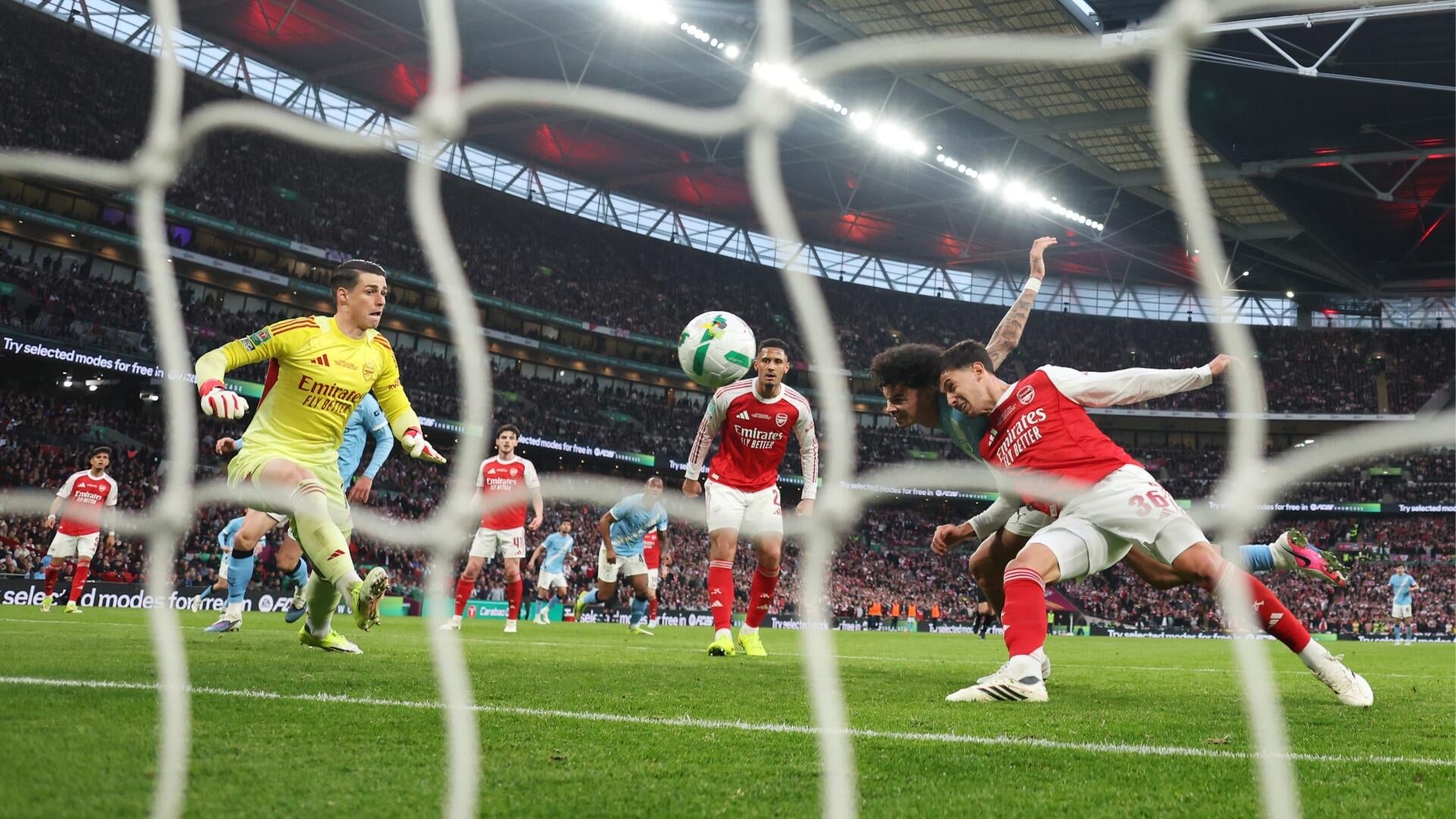
When Nico O’Reilly ghosted in at the back post for his second, he was one of seven City players in the attacking penalty area. As is the norm in an EFL Cup final, the headlines will be stolen by Kepa Arrizabalaga, whose fumbled cross-handed O’Reilly his first, but if it had not been Arsenal’s understudy goalkeeper, might it have been someone else? For perhaps the first time this season, it felt like Arteta’s players could not control the game without the ball.
CBS Sports
That is partly due to what City did well. Even before they started running at Arsenal, their press was suffocating their opponents. There was nothing particularly complicated to what Guardiola asked of his front four, they simply set up a wall that blocked the outballs to Martin Zubimendi and Declan Rice and challenged Arsenal to work their way around or over. The latter did not really work once Kai Havertz began to tire after a bright start; it does not speak favorably of Viktor Gyokeres that his teammates did not fancy him one-on-one against the speedy but booked Abdukodir Khusanov.
Of course, Arsenal could and in very recent history would have backed themselves to work through the lines of blue shirts. It is only a few years ago that you would have had Oleksandr Zinchenko drifting infield to offer another body for interplay. Maybe Jorginho or Granit Xhaka wouldn’t have needed it. Without Martin Odegaard today, they had nothing but William Saliba, who had his hands full with Erling Haaland to begin with. Rice and Zubimendi could not find the angles to get free. The former received one pass in the first 20 minutes. The latter received none.
David Raya was missed, too. In the pre-match warm-ups, he and Tommy Setford were applauding Kepa for getting his long passes on target. Arsenal’s No.1 needs no such praise. His ability to break the lines from the very back of the pitch is hard to find; its absence keenly felt when the team is hemmed in.
When City amped up the intensity, Arsenal found themselves throttled. Between the start of the second half and the 71st minute, they completed a total of zero progressive passes. Take a look at the graphic below, which tracks how a team moves the ball up the field. Or in Arsenal’s case, tracks their attempts to recreate Picasso’s The Weeping Woman using the Wembley field as their canvas, a football as their brush.
CBS Sports
“In the second half we had, especially in the first 18-20 minutes, some issues to get out from that block, to press them better and especially to manage the ball, when we regained it, much better than when we did,” said Arteta.
“Sometimes you have to give credit to the opposition as well when they are so good in these periods, and they capitalise on that, and we had our periods, we didn’t, and then we have to accept that.”
City’s success up high comes with a question: why doesn’t everyone do this against the best teams? There’s an obvious answer. Most of them can ruthlessly punish their opponents if they get through just once. Forwards who threaten you in behind or with their dribbling have defenders, even those with Khusanov’s recovery pace, just checking their position an iota or two as the rest of their team steps forward to press. That opens up the gaps that Rice and Zubimendi needed and from there Arsenal could have gone.
The one problem? Arsenal are not that sort of elite team. Their defense might only buckle when a City-level team is at the peak of its powers but their attack can run aground with greater frequency.
Leandro Trossard has yet to score in 2026. Bukayo Saka has two. Gyokeres has had his moments this year but in over nine hours against Aston Villa, Liverpool, Manchester City and Manchester United he has four shots and no goals. Three of them came in one game against Unai Emery’s side. That is vanishingly light production for a forward who doesn’t offer a lot beyond shots.
It is no exaggeration to say that Arsenal’s most dangerous attacker in this game was Riccardo Calafiori, two shots in 25 minutes and as many progressive passes as anyone not named Saliba. That need not be the case when Odegaard and Eberechi Eze return or if Havertz is able to play the full 90 as well as he did the first 30. For all that Arsenal fell off a cliff in the second half, they had City at arms’ length in the first and might well have held out in time for Arteta to adjust had the excellence of their opponents not coincided with Kepa’s costly error.
And yet, this result threatens to be the sort to send jitters through a fan base that is not well suited to handling a fortnight of introspection. The best-case scenario is that it serves as a warning of what needs fixing in time for the meeting between these two that really matters, the trip to the Etihad in 28 days where Arsenal will define their season. Every one of the three defeats over 49 games before this one were followed by impressive unbeaten runs. “There will be a lot of aspects that we will discuss,” said Arteta of what can be learned from this defeat. “I think we have to reflect on that, bring the temperature down a little bit and we will discuss that.”
While Arteta is looking to cool the nerves, his counterpart has the feel of something long smouldering and might now be catching flame at just the right moment. “The team is underneath, a smell that can flourish,” said Guardiola. “Winning helps to [speed up] the process.
“The players proved again — the old ones especially — that when required to do something that during the season we have not done consistently, especially without the ball, against that team, to achieve that level, we achieved it.”
They did so without any fear. They played in the front-footed fashion of a team who believed that Arsenal could not do anything to them that would inhibit them. That augurs very dangerously for the next time these two face off.