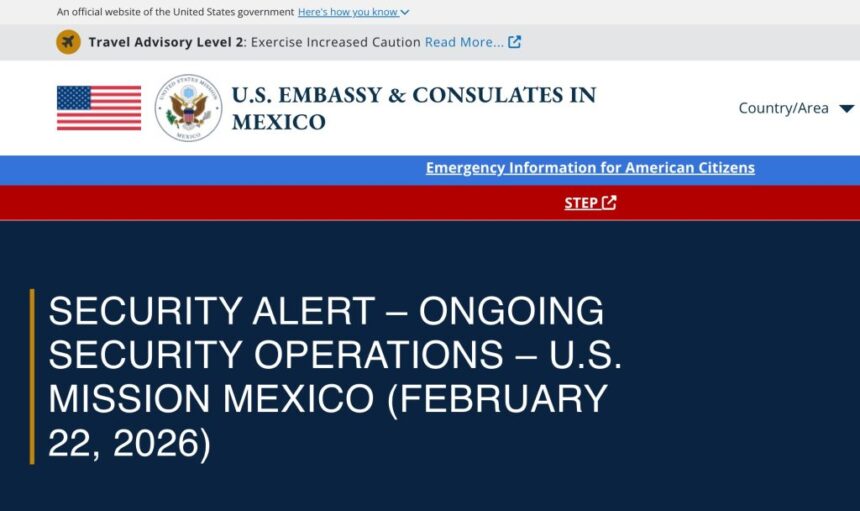
The U.S. Embassy and Consulates in Mexico issued a security alert on February 22, 2026, urging American citizens in multiple Mexican states to shelter in place following a wave of cartel violence triggered by the killing of a top drug lord.
The advisory came hours after authorities confirmed the death of Nemesio Oseguera Cervantes, known as “El Mencho,” leader of the Jalisco New Generation Cartel (CJNG), during a military operation.
In its notice, the U.S. Mission to Mexico warned that “due to ongoing security operations and related road blockages and criminal activity, U.S. citizens in the named locations should shelter in place until further notice.” The alert applies to Jalisco State—including Puerto Vallarta, Chapala, and Guadalajara—Tamaulipas, parts of Michoacán and Guerrero, and Nuevo León. A separate State Department update also referenced heightened risks in Baja California, Quintana Roo, Guanajuato, and Oaxaca.
The violence erupted after Mexican special forces captured El Mencho in the town of Tapalpa, Jalisco. According to Mexico’s Ministry of Defense, the cartel leader was seriously injured in a firefight between his security detail and military commandos. He later died in custody while being transported to Mexico City. At least six of his bodyguards were killed in the operation, and three Mexican military personnel were injured.
El Mencho had long been considered Mexico’s most wanted man, with the United States offering a $15 million reward for information leading to his capture. U.S. Press Secretary Karoline Leavitt described him as a “top target for the Mexican and United States government as one of the top traffickers of fentanyl into our homeland.” Mexican officials said the raid was carried out by the army with support from the National Guard and Air Force, and that “complementary information” provided by U.S. authorities assisted the operation.
Within hours of confirmation of his death, CJNG members launched coordinated retaliatory attacks across at least 20 states. Cartel operatives set fire to buses, trucks, banks, and pharmacies, and erected burning roadblocks using commandeered vehicles. In some areas, spikes and nails were scattered across highways to disable traffic.
Dramatic footage circulated on social media showed plumes of black smoke rising over cities, including Puerto Vallarta and Guadalajara. At Guadalajara International Airport, travelers were seen running and crouching amid reports of gunfire near a nearby highway. Authorities later dismissed rumors of shots fired inside the terminal, though a burned-out vehicle was reportedly found along the road.
In Puerto Vallarta, a major Pacific coast tourist destination, around 300 visitors were stranded after flights were canceled due to the unrest. Local officials transferred travelers to the city center under heavy police escort. One tourist described the situation as resembling “a war zone,” as smoke billowed from burning cars across several neighborhoods.
The governor of Jalisco declared a “code red,” suspending public transportation, canceling public events, and halting in-person classes. El Universal reported more than 250 road block incidents across affected states. Security officials later stated that approximately 90 percent of the blockades had been cleared, though tensions remain high in CJNG strongholds.
Mexican President Claudia Sheinbaum urged citizens to remain calm. “In most parts of the country, activities are proceeding normally,” she said, while praising the armed forces for the operation against El Mencho.
The U.S. Embassy advised Americans to avoid areas of law enforcement activity, monitor local media, and maintain contact with family members. Citizens were reminded to call 911 in emergencies and to enroll in the Smart Traveler Enrollment Program (STEP) for real-time updates.
While authorities continue efforts to stabilize the affected regions, the embassy’s shelter-in-place guidance underscores the volatile aftermath of one of the most significant anti-cartel operations in recent years.