You know what they say: the longer you stick around somewhere, no matter if it seems to have come straight out of a fairytale, you start taking things for granted.
Unlike most people, who save up for years to come to Europe on a two-week summer trip every once in a while, I live right in the heart of it. To be more precise, I’m a proud adopted frog eater who calls France home.
Castles are not something I usually come across in movies or fantasy novels only. Like, Paris’ outer suburbs of Vincennes, with its landmark moated château, are my jogging grounds at the weekend, know what I’m saying?
🏰
VS
🤯
Wait. These Are Real?
Forget Disney. These 5 spots are 100% authentic.
REVEAL HINTS
👆
THE FAIRY TALE 5
🇬🇷 The Knight’s City
🇫🇷 The Painted Port
🇧🇦 The Phoenix Bridge
🇩🇪 Disney’s Muse
🇷🇴 Dracula’s Home
👇 SCROLL FOR FULL GUIDE
5 Medieval Towns That Made Me Fall In Love With Europe Again
I’ve visited over 100 medieval towns over the years, if not a much-higher number, and I rarely ever get impressed at this point.
Cobbled streets? Lovely to stroll (if you watch your step). A hilltop fort overlooking gabled roofs? Cute, but seen it before. Church squares surrounded by cafés? They’re nice-enough, alright, but after a gazillion of them, I can’t even bother getting my phone out for pictures.
Now, there have been the odd few exceptions: towns that, despite my nonchalant attitude towards what’s become trivial at this point, still managed to completely alter my terminally European brain chemistry.
Maybe it was just the good mood I was in, but these 5 European gems and their Old World allure totally snuck up on me, and made me feel those tummy butterflies I’d been missing for far too long when rolling up to a new train station:
Rhodes Town, Greece


Forget the Santorinis and Mykonosos of the world: if you ever happen to be island-hopping around Greece, and you’re looking to get your mind blown, head straight for this timeless port city in the eastern Dodecanese archipelago.
The capital of the namesake island, Rhodes is a UNESCO-listed medieval town with the kind of diverse architecture you can’t easily find in your average whitewashed Cycladic village.
First of all, it’s the largest inhabited medieval center in Europe, with stone-cut houses, arch-framed passageways, and a maze of cobblestone streets that seem to go on forever—and the coolest part? It’s all wrapped in Indiana Jones–level ramparts, turrets, and massive city gates.


Rhodes Town was fortified by the legendary Knights of St. John in the Middle Ages, many of whom were French. It’s no surprise that the auberge-lined Street of the Knights, a ruined Gothic cathedral, and a visibly French-influenced Palace of the Grand Master are some of the main sights here.
At the same time, within only a few steps of an overwhelmingly Western European ensemble, you’ll find Ottoman-era baths and minarets scattered around the skyline—a result of roughly five centuries of direct Turkish rule—and though the Italians have only been here briefly, from 1912 to 1943, they made sure they left their mark along the Mandraki harbor’s Italianite civic buildings.
Rhodes town is a fascinating mix of cultures, and the meeting point of several civilizations that shaped the Middle Ages as we know it.
Honfleur, France

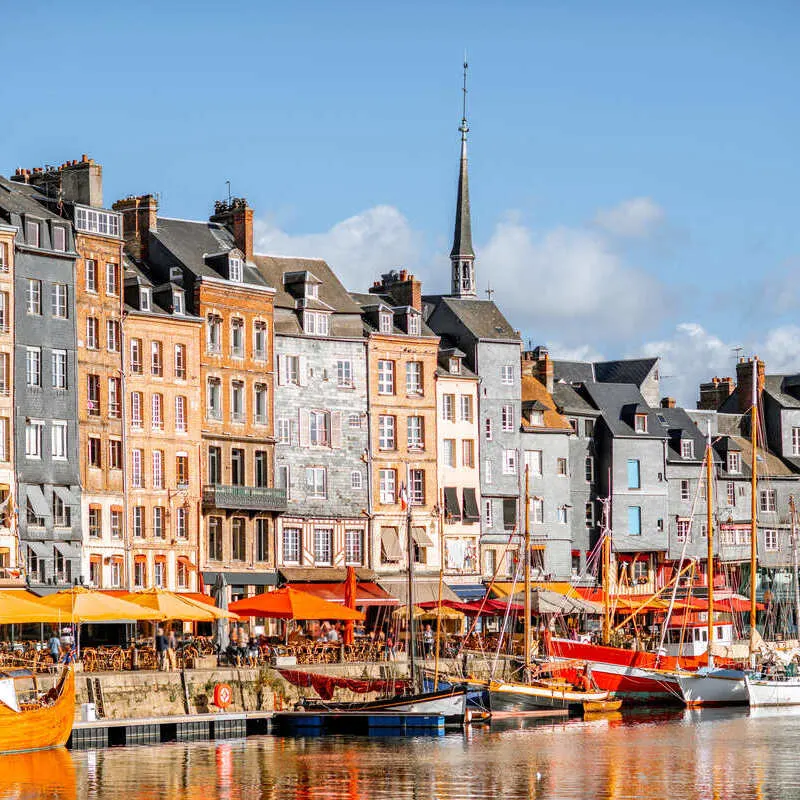
Speak of the devil… A picture-perfect harbor town in Normandy, in the north of France, Honfleur is what I like to call personally Copenhagen and Amsterdam’s love child:
Its Vieux-Bassin, or Old Harbor, is lined with well-preserved, slender, closely-packed-together townhouses, some of which date as far back as the 1500s. Their satisfying muted tones reflect beautifully on the water, and the wooden fishing boats and screaming gulls only add to the atmosphere.
I especially love Honfleur for how unmistakably French it feels: the beret-wearing Instagrammer, flitting around Paris in a flying princess dress, hasn’t made it here yet, and the cobblestone streets, half-timbered houses, and riverfront charm are unrivaled.


Honfleur is also the birthplace of Eugène Boudin, so it’s no wonder the entire townscape looks like an Impressionist painting come to life, and in case you didn’t know, France’s oldest wooden church, still standing, the Hundred Years’ War-era Église Sainte-Catherine, is right here.
Of course, there’s no way you’d come to Honfleur and pass up on a proper brasserie lunch at Huître Brûlée: this is where you’ll get the absolute freshest oysters in town, and you’ll be surprised by how well they pair with a local Calvados spirit.
Mostar, Bosnia and Herzegovina


If you ever find yourself in Dubrovnik, Croatia, and its jam-packed Stradun and Game of Thrones walking tours don’t quite live up to the telly hype, make it a priority to hop over the border into Bosnia and Herzegovina and check out the far more quaint and arguably prettier Mostar.
An unassuming medieval gem with a fascinating, yet dark past, it revolves around an elegant stone arch bridge spanning the emerald-green Neretva River. This bridge is possibly the most easily-recognized landmark in all of Bosnia, if not the Balkans, and it was originally built in the 16th century by the Ottomans.


Sadly, the original one got destroyed during the Bosnian War of the nineties, but this 2004 reconstruction leaves nothing to be desired: they plucked out the pale limestone from the exact same quarry, and even fragments of the old bridge that were lying at the bottom of the river were retrieved and incorporated.
Mostar is a town reborn from the ashes, and maybe that’s why it holds such a special place in my heart:
As you walk around its otherwise picture-perfect Old Town, paved with uneven cobbles and filled with Turkish-style bazaars, you might catch a glimpse of bullet holes on some building façades, and even war machinery rusting away in overgrown backyards.


Mostar isn’t just another overly-polished, Disney-fied medieval town that welcomes the clueless Dubrovnik-bound tourists with fake history and staged pleasantries: it feels actually lived in, genuine, and largely unbothered by the humdrum caused by the occasional daytime visitors.
For drone-like views of Mostar’s Old Town and its beautiful Stari Most (the Old Bridge), climb up the minaret of Koski Mehmed Pasha Mosque, and for those visiting in summer, keep an eye peeled for the town’s bridge jumpers and their mid-air acrobatics.
Meißen, Germany

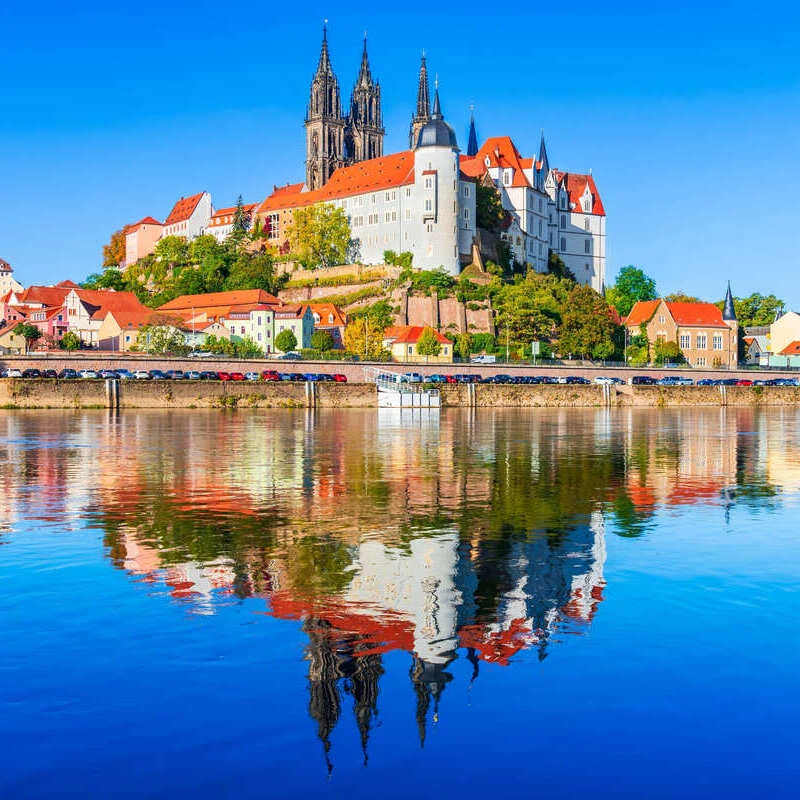
A half-hour drive from Dresden, Meißen (or Meissen) is one of those showstopping places you pull up to with the car, and you just have to park on the roadside lookout to take it all in first.
Picture a monumental, cream-colored castle towering over the Elbe River, with romantic towers and spires that could only have been sketched by Walt Disney himself. Except this is the real deal, not the copycat, concrete, styrofoam version you get in the parks.
Meißen’s ‘Altstadt’, its labyrinthine Old Town with narrow stone-paved streets flanked by centuries-old buildings, is an absolute delight to stroll, and I’d gladly come back there in a heartbeat just for another bite of Café Residenz’s marzipan treats.
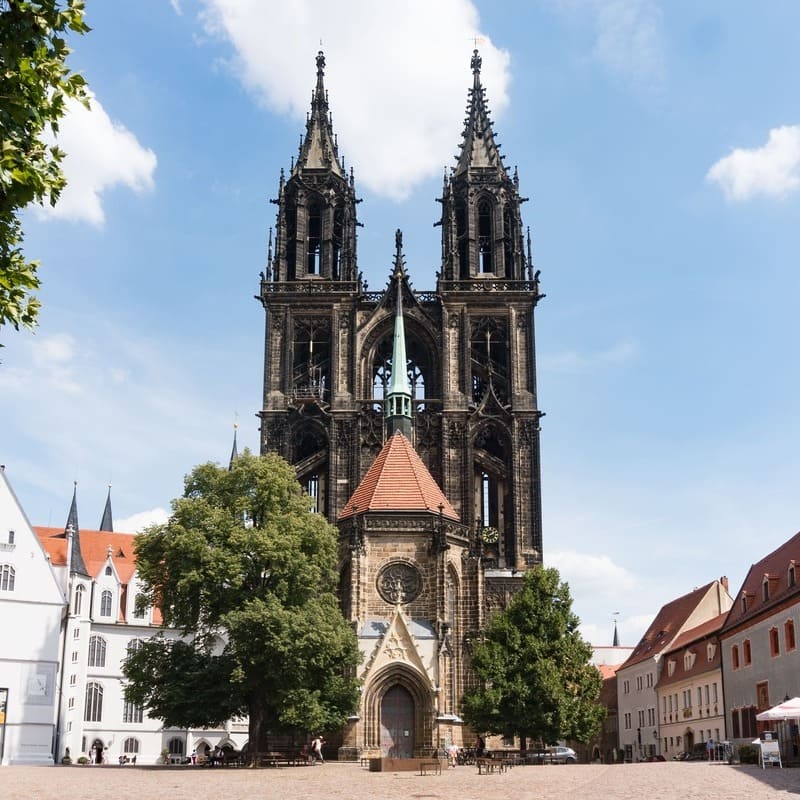
Given the many stunning medieval towns that can be found all around Germany, you’re probably wondering why I’m going for this one in particular. Well, unlike most historic German settlements, Meißen wasn’t completely ravaged by World War II:
Everything you see, from the timbered housefronts to their stepped gables, and the majestic cathedral, located in the main court of the Albrechtsburg (the town’s castle), is practically exactly as it was in the 15th century—believe it or not, that’s not something you see every day in Germany.
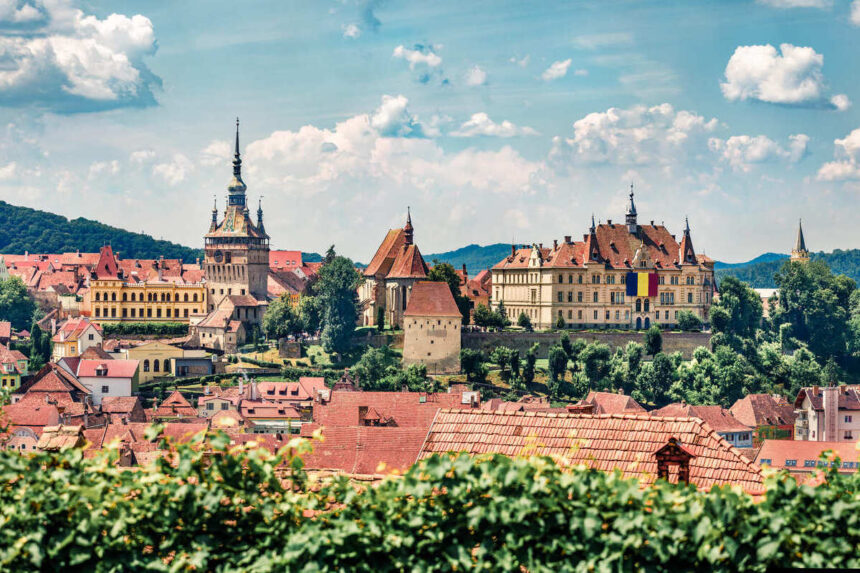
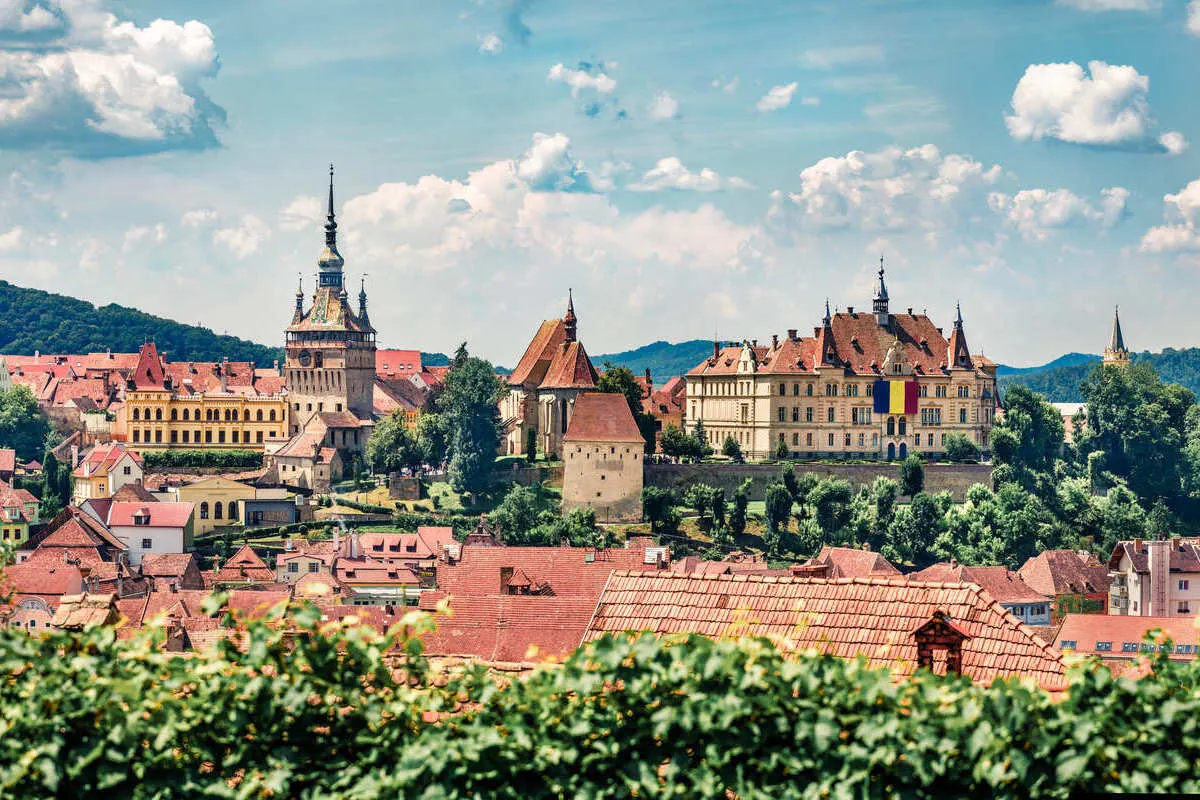
Sighișoara, Romania


Lack of civil rights aside, I do feel we look back on medieval times somewhat fondly now, as an idyllic time of chivalric tales, damsels in distress, and dreamy forts perched atop vertiginous clifftops. When you truly think about it, though, medieval towns can be a little… creepy.
The pointy spires, pathways flanked by forward-leaning houses, and eye-shaped dormers that are constantly watching you in quiet corners. Add to that the atmospheric morning mist, and a resonating church bell, and you get a pretty-accurate picture of Sighișoara:
Possibly Romania’s eeriest town, nestled in the confines of a mystical Transylvania.


Walking around Sighișoara, I couldn’t help but feel it is the perfect backdrop for the umpteenth Hollywood medieval flic: it has the stone-built bell tower, hidden passageways you’re never exactly sure where they might lead, and the low-light, lamp-lit squares at dusk.
Oh, and maybe it’s a good time to mention that Vlad the Impaler, the historical, ruthless ruler that inspired Bram Stoker’s Dracula novel, hails from… here. Color me shocked.
Needless to say, the town leans heavily into the whole vampiric lore, with countless statues, horror-themed details, and fascination for the macabre, best experienced in Vlad’s very own birth house, now a museum at the core of the citadel.
Don’t fret. The only thing that bites around here is the odd playful black cat.

Subscribe To Our Latest Posts
Enter your email address to subscribe to Travel Off Path’s latest breaking travel news, straight to your inbox.