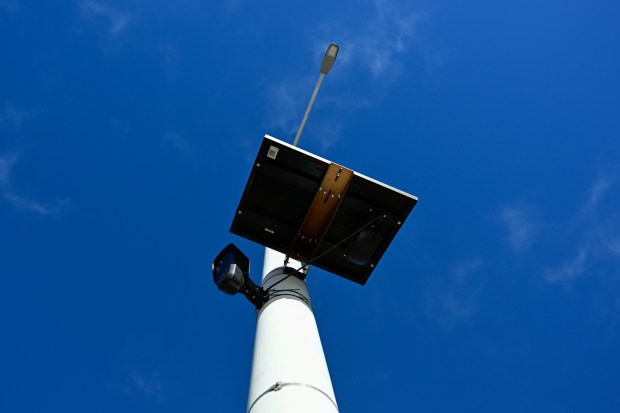
There are just 16 Flock Safety cameras in Thornton.
But those electronic eyes, mounted to poles at intersections throughout this city of nearly 150,000, brought out dozens of people to the Thornton Community Center for a discussion on how the controversial license plate-reading cameras are being used — and whether they should be used at all.
Law enforcement agencies cite the automatic license-plate readers, or ALPRs, as a powerful tool that bolsters their ability to locate and stop suspects who may be on their way to committing their next assault or robbery.
But Meg Moore, a six-year resident of the city who is helping spearhead opposition to Flock cameras, said she worries about how the rapidly spreading surveillance system is impacting residents’ privacy and Fourth Amendment protections against unreasonable searches and seizures. Thornton’s Flock camera data can be seen by more than 1,600 other law enforcement agencies across the country.
“We want to make sure this is truly safe and effective,” she said in an interview.
The debate over Atlanta-based Flock Safety’s cameras, which not only can record license plate numbers but can search for the specific characteristics of a vehicle linked to an alleged crime, has been picking up steam in recent years. The discussions have largely played out in metro Denver and Front Range cities in recent months, but this year they reached the state Capitol, where lawmakers are pitching a couple of bills to tighten up rules around surveillance.
The number of police agencies contracting with the company now exceeds 6,000, according to the company. The critical “DeFlock” website uses crowdsourcing to tally the number of Flock cameras out there. At the latest count, the website lists nearly 74,000 Flock cameras operating nationwide.
Metro Denver alone is home to hundreds of the cameras, according to DeFlock’s map.
In Denver, Mayor Mike Johnston has been butting heads with the City Council over the issue. Johnston is so convinced of Flock’s value in combating crime that in October, he extended the contract with the company against the wishes of much of the council. Denver has 111 Flock cameras.
In Longmont, elected leaders took a different approach. Its City Council voted in December to pause all sharing of Flock Safety data with other municipalities, declined an expansion of its contract with the company and began searching for an alternative.
Louisville beat its Boulder County neighbor to the punch by several months, disabling its Flock cameras at the end of June and removing them by the start of October. City spokesman Derek Cosson said privacy concerns from residents largely drove the city’s decision.
Steve Mathias, a Thornton resident for nearly a decade, would like to see Flock’s cameras gone from his city. Short of that, he said, reliable controls on how the streetside data is collected, stored and shared are paramount.
“In our rush to make our community safe, we’re not getting the full picture of the risks we’re facing,” he said. “We’re making ourselves safe in some ways by making ourselves less safe in others.”
The hot-button debate in Thornton played out at last month’s community meeting and continued at a City Council meeting last week, where the city’s Police Department gave a presentation on the Flock system.
Cmdr. Chad Parker laid out several examples of Flock’s cameras being instrumental in apprehending bad actors — in cases ranging from homicide to sex assault to child exploitation to a $5,700 theft at a Nike store.
As recently as Monday, Thornton police announced on X that investigators had tracked down a man suspected of hitting and killing a 14-year-old boy who was riding a small motorized bike over the weekend. The agency said a Flock camera in Thornton gave officers a “strong lead” in identifying the hit-and-run suspect within 24 hours.
At the Feb. 3 council study session, police Chief Jim Baird described Flock’s camera system as “one of the best tools I’ve seen in 32 years of law enforcement.”
But that doesn’t sway those in Thornton who are wary of the camera network.
“I’m not a fan of building toward a surveillance state,” Mathias said.
The hazards of a system like Flock, he said, lie not just in the pervasive data-collection methods the company uses but also in who eventually might get to see and use that data — be it a rogue law enforcement officer or a hacker who manages to break into Flock’s database.
“A person who wants us to do us harm with this system will have as much capability as the police have to do good,” he said.
Crime-fighting tool or prone to misuse?
In November, a Columbine Valley police officer was disciplined after he accused a Denver woman of theft based in large part on evidence from Flock cameras, according to reporting from Fox31. The officer mistakenly claimed the woman had stolen a $25 package in a nearby town and said he’d used Flock cameras to track her car.
“It’s putting too much trust in the hands of people who don’t know what they’re doing,” DeFlock’s Will Freeman said of so many police agencies’ adoption of the technology.
Last summer, 9News reported that the Loveland Police Department had shared access to its Flock camera system with U.S. Border Patrol. That came two months after the station reported that the department gave the Bureau of Alcohol, Tobacco, Firearms and Explosives access to its account, which ATF agents then used to conduct searches for Immigration and Customs Enforcement.
Parker, the Thornton police commander, said any searches connected to immigration cases or to women from out of state who are seeking an abortion in Colorado — another scenario that’s been raised — “won’t ever touch our system.” State laws restrict cooperation with federal immigration authorities and with other states’ abortion-related investigations.
“Any situation I feel uncomfortable about or that might be in conflict with our policies or with Colorado law, I will revoke their access — no problem,” he said.
Thornton deputy city attorney Adam Stephens said motorists’ Fourth Amendment rights are not being violated by the city’s Flock camera network. During last week’s meeting, he cited several recent court cases that, in essence, determined that there is no right to privacy while driving down a public roadway.
In an interview, Stephens said Thornton was “in compliance with the law.”
Flock spokesman Paris Lewbel wrote in an email that the company was “proud to partner with the Thornton Police Department to provide technology used to investigate and solve crimes and to help locate missing persons.”
Lewbel provided links to two news stories about minor children who were abducted and then found with the help of Flock’s cameras in Thornton and elsewhere.
At the council’s study session last week, Parker provided more examples of Flock’s role in fighting crime and finding missing people in Thornton. They included police nabbing a suspect who had hit and killed a pedestrian, locating a burglar who was suspected of robbing several dispensaries, and tracking down an 89-year-old man with dementia who had gotten into his car and gotten lost.
“It allows us to find vehicles in a manner we weren’t able to previously,” Parker said of the camera network.
Thornton installed its first 10 Flock cameras in 2022 and then added five more — plus a mobile unit — two years later. The initial deployment was in response to a spike in auto thefts in the city, which peaked at 1,205 in 2022 (amid an overall surge in Colorado). Thornton recorded 536 auto thefts last year.
The city says Flock cameras have been involved in 200 cases that resulted in an arrest or a warrant application in Thornton over the last three years.
Thornton police have access to nearly 2,200 other agencies’ Flock systems across the United States, while nearly 1,650 law enforcement agencies can access Thornton’s Flock data, according to data provided by the city.
For Anaya Robinson, the public policy director for the American Civil Liberties Union of Colorado, the networked nature of Flock cameras across wide geographies is a big part of the problem. By linking one police agency’s Flock technology with that of thousands of other police departments, it “creates a surveillance environment that could violate the Fourth Amendment.”
The sweeping nature of Flock’s surveillance is also worrisome, Robinson said.
“You’re not just collecting the data of vehicles that ping (a police department’s) hot list (of suspicious vehicles), you’re collecting the data of every vehicle that is caught on a Flock camera,” he said.
And because the technology is relatively inexpensive — Thornton pays $48,500 to Flock annually for its system — it’s an affordable crime-fighting tool for most communities. But that doesn’t mean it should be deployed, DeFlock’s Freeman said.
Fight remains a largely local one
State lawmakers are crafting bills this session to limit the reach of surveillance technologies like Flock’s.
Senate Bill 70 would put limits on access to databases and the sharing of information. It would prohibit a government from accessing a database that reveals an individual’s or a vehicle’s historical location information, and it would prohibit sharing that information with third parties or with government agencies outside the controlling entity’s jurisdiction. Certain exceptions would apply.
Senate Bill 71 would direct a “law enforcement agency to use surveillance technology only for lawful purposes directly related to public safety or for an active investigation.” It also would forbid the use of facial-recognition technology without a warrant and would place limits on the amount of time data can be retained.
Both bills await their first committee hearings.
Thornton says it doesn’t use facial recognition technology. Its Flock data is retained for 30 days.
Regardless of what passes at the state Capitol, the real fight over license plate readers of any type will likely continue to happen at the local level. Thornton’s council plans further discussions on Flock next month.
For Moore, the resident who is leading the charge against the cameras, potential surveillance of the immigrant community is what troubles her the most.
“We want to make sure we’re operating this so that it’s safe for all of our residents,” she said. “Getting rid of the cameras altogether is a tough sell. But there needs to be a conversation about guardrails.”
Mayor Pro Tem Roberta Ayala, a Thornton native, said she has heard a wide array of opinions from her constituents about the advantages and potential downsides of the technology.
“Could it be misused? Yes. Do we want to stop that? Yes,” she said.
But as a victim of crime herself, Ayala also knows the immense damage and disruption that crime causes victims and their families, be it a stolen vehicle or something much worse. And as a teacher, Ayala is concerned about achieving justice for the families of children who are harmed or abused.
“If it can save even five kids,” she said, “I want the cameras.”
Stay up-to-date with Colorado Politics by signing up for our weekly newsletter, The Spot.