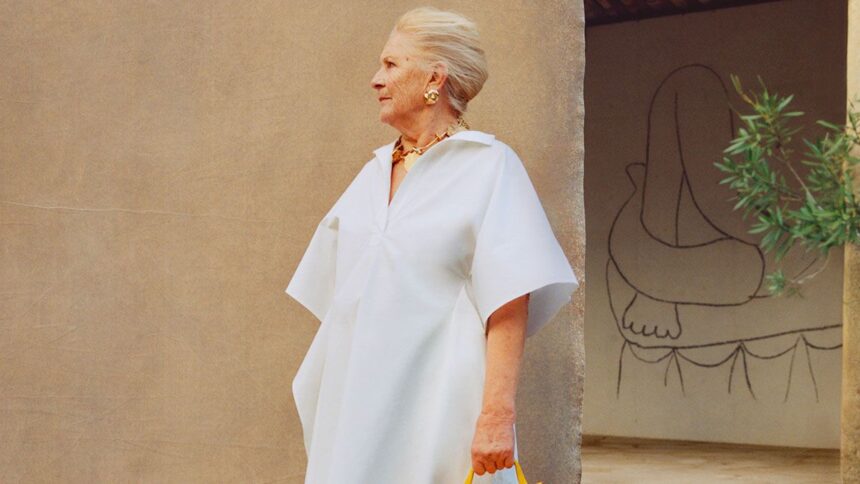
When Simon Porte Jacquemus teased the announcement of his first-ever brand ambassador, attention turned to the obvious candidates from his A-list inner circle, like Dua Lipa or Blackpink’s Jennie. But when the announcement arrived, the designer had swapped celebrity for something far less replicable: his personal history. The brand’s first ambassador is his grandmother, Liline.
“Before Jacquemus existed, she was already my inspiration,” Jacquemus wrote on Instagram, announcing the move. “Her strength, her elegance, her authenticity… she shaped the way I see women, and the way I imagine this maison.”
“Friends and family casting is a reminder that even within fashion’s most performative moments, there are real humans at the center,” says Katie Devlin, fashion trends editor at Stylus. “There’s a sense of distrust simmering across the board. Consumers are growing weary of slick and glossy perfection, so family and community casting feels like a breath of fresh air when done correctly.”
As artificial intelligence accelerates replication, influencer culture reaches saturation, and global crisis seeps into the consumer consciousness, the industry’s reliance on scale as a proxy for value is losing traction. In a market bloated with spectacle and increasingly disconnected displays of wealth, amplification alone is no longer enough. Distinction is being recalibrated around what cannot be automated or reproduced, and personal history has emerged as a point of differentiation for today’s creative directors. Across the Fall/Winter 2026 season so far, we’ve seen designers pay homage to the family members, mentors, artisans, and models that have shaped them and their careers.
Before his recent Dior Haute Couture debut for spring 2026, creative director Jonathan Anderson invited his design “hero” John Galliano, Dior’s creative director from 1997 to 2011, to the atelier for a preview. For the show invitation, guests received a small posy of cyclamen tied with black silk ribbon, an homage to a bouquet Galliano had brought to the visit. “The most beautiful flowers I had ever seen,” Anderson wrote on Instagram, explaining that he wanted everyone to receive the same gesture that had marked the collection’s beginning. This acknowledgment of and respect for his predecessor is a gesture rarely extended in an industry inclined to sever creative lineage rather than reference it.
Anderson also invited atelier artisan Paulette Boncoure — who began working at Dior in 1947 — to attend the couture show, a decision that was widely welcomed online. “Finally, someone worthy of being recognized for their hard work and passion. She deserves more attention than those influencers,” one user commented on Instagram. Following the show, Dior mounted an exhibition of the looks, inviting schoolchildren to visit and draw the pieces. “My dream for Dior Haute Couture was more than just a fashion show,” Anderson wrote in a post about the schoolchildren, which has since garnered more than 125,000 likes. “I wanted it to be something to share with everyone.”