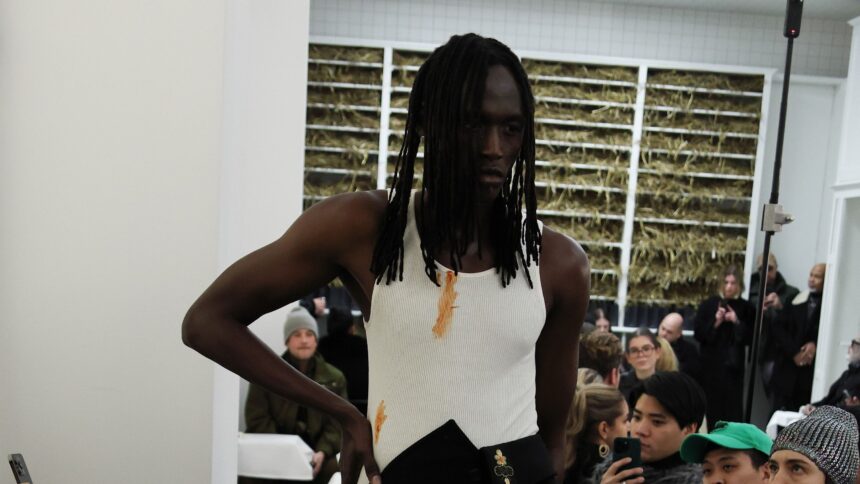
Well, I don’t even know where to begin about the Richert Beil show, the latest from the label designed by creative and life partners Jale Richert and Michele Beil. It might be one of the most bizarre—in a good way—shows I have ever been to, and God knows I’ve seen a few. Maybe it’s best to start at the beginning, with an email a few days earlier asking for dietary restrictions (no meat, please) and clothing size (I’m tall, so, um, XL?). Cut to the show venue, the new-ish Richert Beil store in Berlin’s Kreuzberg district one bitterly cold night, where the runway is flanked by chairs with tiny swing tables dressed in crisp tablecloths and seat numbers. (I’m number 51.)
There’s a concise and elegant menu of four courses, which turn out to be teeny-tiny, and cooked by their good friend, a chef called Chehub: The Rolls (a vegan sushi hand roll; good); The Pillow (a piece of red pepper enveloped in a crisp, papery, minute parcel; delicious); The Shot (bouillon, my seatmate Tim Blanks tells me with some authority; not my favorite); and, lastly, The Egg, which is ostrich sized and served to us with a pair of worryingly large surgical tweezers. The egg has a small hole and I use the tweezers to tease out…a pair of black lace knickers, size XL. “Edible?” Tim asks me. And all the while, as a balletic movement of wait staff dispenses these micro courses, the new collection appears, models weaving in and out, and very good it is too.
Richert Beil the brand makes creative, clever yet very believable clothes, most always in black, and in the few seasons I’ve seen their shows those clothes have only gotten better. The new collection plays to the designers’ strengths: the imaginative and ever so slightly perverse way they love to tailor, while still rooting it in its classic traditions, from the jackets with button-fastening panels to pants seamed with lines that mimic underwear, the way they like to fit and drape latex as if it was couture silk, and all their clever ideas around shirting. It turns out the wait staff are modelling the new collection too: There are striped, black tunic-y shirts that mimic chef garb, and white shirts with elegant, folded lines that echo the way someone in the kitchen might hurriedly throw a towel over their shoulder.
The best look, the first out, turns out, they tell me backstage after the show, comes from their very first collection, a re-do of a fantastic black coat with Bavarian gilded embroidery typical of southern Germany, and an accordion pleated back. They styled it as a skirt, almost Edwardian in look, with its bustle and train, but then put it with the most quotidian white cotton tank. “It was the idea that someone had just come out of the kitchen, and they’re looking a bit dirty, so they just wrap the coat around them to give this couture look,” Beil said.
Yet the idea for hosting a dinner during the show came from this longing to do something that would bring people together in the most fundamentally human way; something tangible and everyday and communal; a rite that feels almost primal. It also came from Richert Beil’s belief in bucking against the inexorable move to AI, and the likes-fueled virtual world; to keep fashion rooted in something physical to the point of being visceral. “We were thinking, ‘What’s the future going to look like?” Beil said. “What can’t be replaced?” Well, gathering for dinner, for one thing. The point for both of them, they say, was never to get into fashion as a performative exercise, but to create real and lasting things. “It’s all become, how fast can you scale, and how many things can you produce,” Richert said. So, this is their response: Take it slowly, make it slowly. And even better when you get a bite to eat too.