The signature poeticism of Marke was evident before we’d even seen as much as a single stitch of clothing at the label’s fall 2026 show. Marke founder and designer Mario Keine had decorated the runway with piles of antique books, some of which had been left lying open, and roses so faded and aged that they’d become newly beautiful, the blooms as timeworn and fragile as the pages of the books.
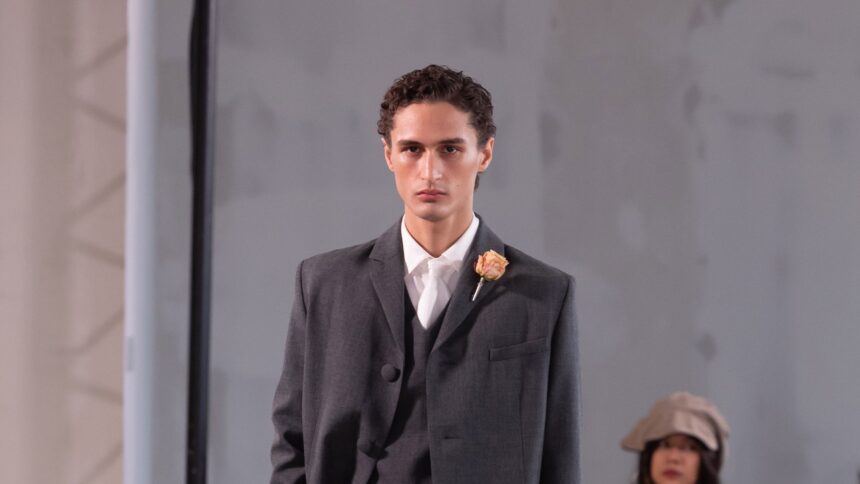
All of this made for the perfect setting for his collection, which moved in an accomplished and ambitious forward direction; the Cologne-based Keine is serious about his craft, and it shows. He has made a bit of a name for himself by the way he draws on historical tailoring from the 18th and 19th centuries, with frock coats, waistcoats, and billowing shirting, their collars romantically crumpled and askew, before adding an undertow of subversion and slyness into the mix. Fall 2026, with its emphasis on the sobriety of buttoned-up gray and black suiting, twisting it by pairing his crisp jackets with wide shorts and voluminous pants, and yet more of those buds on the edge as extinction worn as boutonnieres, was no exception.
Moments before the show began, Keine was backstage, rapidly tying, re-tying, and tying again the belt of a marine blue jacket, while explaining where his head was at with this collection. “Every season, I start with what I’m feeling strongest about,” he said, “and I’ve been thinking a lot about the feeling we get when we’re consuming media now—the disinformation, the commentaries, everything on social media, and how it can be like a punch in the stomach. It gives me this sense that in 2026 it’s comparable to the pre-Enlightenment era of the 17th century, and like then, we need to be questioning and challenging everything. And,” he went on to say, “it’s like we’re kind of living in this neo-Rococo world today, with a monetary elite, and where social media is like paste-tinted hedonism. It resembles the era just before the French revolution, and that’s where the collection’s references have come from.”
While a centuries-old febrile fomenting of radical change was his starting point, Keine’s collection was as much evolution as it was revolution. He might have channelled foppish 18th century flourishes—the poet’s shirts, the flowers, the dotted, ornate, fabrications—but there was also a distinctly 21st century vibe at work. Keine leant into a cleaner, leaner distillation of tailoring codes, which he described as corporate core, which firmly brought anything historical into the today.
All of which is a long way of saying there were some terrific, thoughtful clothes in here, clothes which while they come from a place of conceptual thought and impulse are also plenty desirable: that opening of a gray high buttoned coat over voluminous pants, for instance, or the crisp cotton shirting which was wittily adorned with a tie made out of an extra sleeve, buttoned cuff and all.