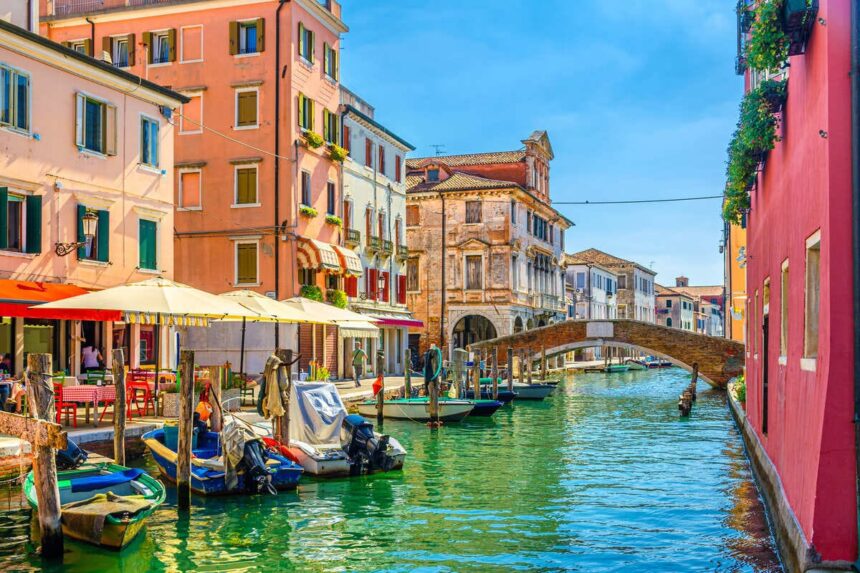
Richly-decorated gondolas traveling down winding canals, monumental Gothic palaces floating atop thousand-year-old wooden stilts, driven deep into a mushy-green lagoon, and of course, every beautiful pastel-colored building in sight:
It’s no wonder tens of millions of tourists flock to Venice to marvel at its Old World wonders every year, and the fact that it’s crumbling under the weight of overtourism is not a surprise, either.

From the outright ban of large boats, to rising overnight fees, and more recently, the introduction of an entry fee for day-trippers who are not staying in Old Town hotels—which, guess what, applies to a majority as most travelers will base themselves in Mestre, Venice’s more affordable neighbor—La Serenissima has had enough of being an Instagrammer playground.
If you’re an American heading to Europe this season, you might want to give good old Venezia a miss unless you’re fine with being hurried along narrow fondamenti, or shouted at by impatient Italians.
The good news is Venice isn’t the only European city known primarily for having canals.
These 5 lesser-known gems built on water offer a similar vibe and are equally stunning in their own way, and believe it or not, crowds are still under manageable levels!
Chioggia, Italy
The Perfect Miniature


A 2-hour vaporetto ride from Venice, across the island-dotted Adriatic, the charming Chioggia is nestled in the far less-touristy southern end of the Venetian Lagoon, with the same fondamenti, winding canals, and pastel-hue edifices that made the Floating City famous (but none of the crowds).
A miniature version of Venice, it’s one of Italy’s oldest fishing towns, and the quality of the food served in canal-facing osterie here is unrivaled. For the best seafood risotto you’ll try in your life, make sure you add Osteria da Nicola to your bucket list.
Of course, Italian grub is not the primary reason why Venice-disillusioned tourists come here:
Chioggia’s main canal, Corso del Popolo, is the Venetian Grand Canal’s less-pompous, unassuming sister, flanked by skinny townhouses and family-owned eateries, and of course, the Cathedral of Chioggia, a 17th-century Baroque masterpiece towering above the canals, is worth the detour alone.
Friedrichstadt, Germany
The Odd-One Out


Dubbed the ‘German Amsterdam’, Friedrichstadt is a tiny town in northern Germany best known for the Dutch-style waterways that cut through its historic center. It’s not exactly Venetian in character, per se, but hey, the canals are there!
If you’re wondering why it feels more like the Netherlands than Germany proper, you should know much of the Old Town follows a Dutch Mannerist design.
It was founded by Dutch immigrants fleeing religious persecution in the 17th century, after all, so it’s hardly a shocker they would have injected their culture and savoir-faire into town planning.
The houses here have steeped gables and timber framing à la Amsterdam, and they line the cutest, postcard-ready navigable canals. The main difference? There are no Instagrammer hordes to be seen, from the café-lined Marktplatz to the scenic Hauptkanal.
Martigues, France
The Lost Provençale Twin

A short half-hour drive from the bustling Marseille, Martigues is a quaint coastal settlement on the shores of the French Mediterranean. Given its gorgeous main canal and colorful waterside buildings, perhaps it won’t be a surprise to you that locals call it La Venise provençale.
The Venice of Provence.
Martigues is built across three main islands, separated by busy waterways and interconnected by footbridges, but the comparisons don’t end there: the narrow Italianate buildings with green shutters, the laid-back vibe, and the fishing heritage truly make it feel like a Provençal echo of Veneto.
No doubt, the food scene here is next level. For legit Marseille-style bouillabaisse or fresh seasonal eats with wine pairings, hit up La Cocotte de l’île: it sits in the heart of the canal district, and for the South of France, mains averaging $19 ain’t bad at all.
Comacchio, Italy
The Distant Cousin

We’re going back south to Italy for this one. You may not know this, but Veneto is not the only region in Italy known for its floating towns: Comacchio, in the confines of Emilia-Romagna, looks (and feels) like a distant cousin of Venice.
Sprawled across several small islets, arranged unevenly by nature in the serene Valli di Comacchio lagoon, it has the typically Venetian, arched bridges spanning canals, colorful buildings, and towering campaniles that have been angling dangerously sideways with the passing of the centuries.
Of course, this one feels a lot more intimate and less over-the-top than Venice, which was once at the center of a powerful maritime empire. Dare we say, locals are also a lot friendlier.
The local “Rialto”, Trepponti bridge, is its iconic multi-arch symbol, but the real showstopper is Renaissance Palazzo Bellini: impossible symmetry, fancy windows, and ornate cornices. Nothing short of a Northern Italian stunner.
Aveiro, Portugal
The Portuguese Look-Alike


Portugal is best known for its hilly port cities, but what if we told you that, halfway between Lisbon and Porto, a few miles inland, there lies a Venice look-alike where decorated flat-bottom gondolas travel down grand canals and azulejo-clad buildings reflect on the water?
Aveiro has been rightfully crowned Portuguese Venice, not only due to its canals and moliceiro boats—pfft, that’s a running theme at this point—but its rich culinary heritage and a plethora of Baroque churches.
Pastel de nata is overrated: you haven’t truly been to Portugal until you’ve sampled Confeitaria Peixinho’s ovos moles.
A Gothic-Baroque mash-up, Aveiro Cathedral boasts a grand interior with gilded altarpieces, and if you think Venice’s Grand Canal is impressive, wait until you’ve strolled down canal-side João Mendonça Street, lined with Art Nouveau façades, intricate tile patterns, and wrought-iron balconies.

Subscribe To Our Latest Posts
Enter your email address to subscribe to Travel Off Path’s latest breaking travel news, straight to your inbox.