Today’s Lemaire show took place at the Opera Bastille, where we sat in a darkened auditorium and faced a gray curtain that rippled with light and shadow.
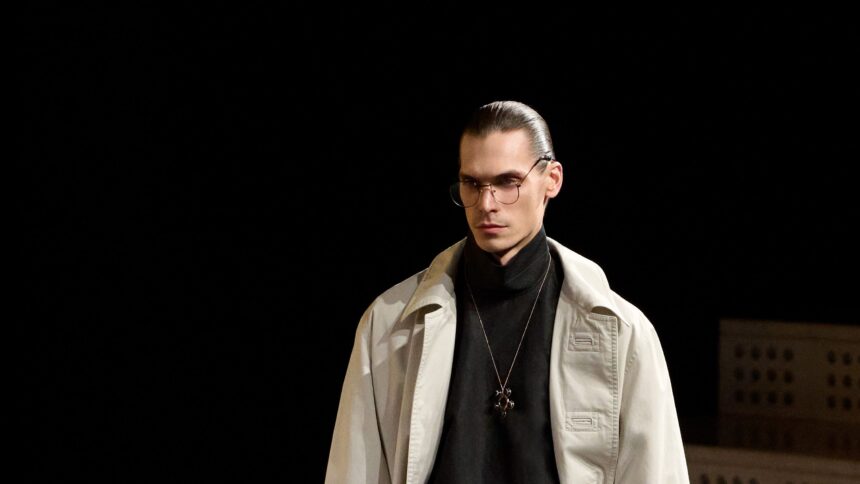
Rather than a continuous runway sequence, models emerged in smaller configurations—seven men, then four women, then a few more men and so forth—representing different themes and attitudes across the collection. The photos here show each individual, yet you can almost reconstruct the groups, from fluid coats over generously proportioned trousers to what looked like jumper-shorts onesies worn with knee-high boots.
In a dressing room post-show, Sarah-Linh Tran described this a “more didactic” way to understand the proportions and color stories. Sure enough, you could appreciate the series of exquisite crushed velvet like liquid metal, the coiled fringe dresses—that’s actress Doona Bae in the black version—or else the two-tone dresses gently interacting with the body.
But there was more going on here than pattern recognition. Titled “Mine Eyes” after Shakespeare’s Sonnet 43 and thanks in part to the stage direction and choreography of director and artist Nathalie Béasse, these were mini scenes that seemed coded with indecipherable yet compelling prompts and movements. One model might move a chair; another would walk into the audience; and then there was dancer Julie Anne Stanzak, who gleefully leapt and twirled in a floaty, buttery yellow dress while clutching her block heels. The guys wearing various jackets in leather and suede were the sartorial equivalent of workhorse actors delivering their lines flawlessly.
“We have a very pragmatic approach to clothes; it’s very much about the daily dimension—something utilitarian and functional,” added Christophe Lemaire. “But at the same time, we also love art, poetry and moods.”
Whereas style is often associated with attitude, mood penetrates on a more ambient level, like a movie or a person’s mindset—it encompasses both the interior and exterior. The Lemaire duo consistently mentions how they lean towards cinema and real-life characters to develop new ideas each season, and even without any specific references, you pick up on what Lemaire describes as an almost philosophical approach that is “super down-to-earth” but also “a little bit irrational.” And where these meet is the desirability sweet spot, be it a quilted skirt that converts to a cape, a sculpted bag shaped like buttocks or even the insertions of impressionist color layered into the earth tones.
At a certain point, the curtain dropped in one fell swoop to reveal an illuminated backdrop, like a mild sunrise, as the music pulsed with greater energy. The cast—always and arguably the most distinctive ensemble of Paris Fashion Week—moved silently while their iridescent surfaces and illustrations by Roland Topor were directing our attention this way and that. If this was more performance than we usually see from Lemaire, it underscored how the brand is not about performance fashion. Its clothes exist to embolden us on the uncontained stage of everyday life.