On a cold, dark, drizzly night in London (what other kind of night is there in January?), a steady stream of nattily dressed fashion and art types could be followed heading down the industrial Old Kent Road in the southeast of the city. Turning off down a lamplit cobbled pavement and past an imposing wrought iron fence, we soon found ourselves inside the Aslyum Chapel, the heart of a complex of 19th-century almshouses. It couldn’t have been a better setting for a John Alexander Skelton show, given his distinctive vision of disheveled, lightly Dickensian glamour, working with the most accomplished makers from across the British Isles.
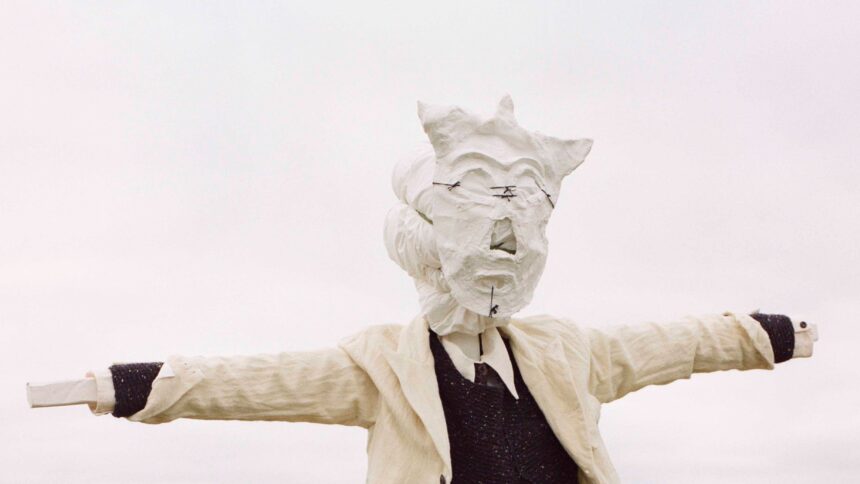
That feeling of having stepped through a portal to a past world was enhanced by the dilapidated interior, complete with peeling plasterwork and cobwebs, and hot cider being served from a tureen, underneath a ceiling patched up with corrugated iron where the chapel was bombed during World War II. Antique chairs had been arranged in concentric circles around a central rostrum, where a spotlight was fixed on one of a dozen or so mannequins that had been placed at the outer ring. Well, not mannequins exactly, as, after peering through the gloom, they turned out to be scarecrows (or crucified figures?) their heads crafted from papier-mache like effigies or totems left over from some ancient pagan ritual, some with little peaked black caps sat atop their heads. “I’ve always been fascinated by scarecrows,” Skelton said after the show, citing his obsession with a ’90s photography book by Colin Garratt. “Some of them are really beautiful and elegant with great coats, and some have this sinister feel. There’s a weird duality where they can feel kitsch and then also quite evil, as if they could spring to life all of a sudden.”
To wit, a masked figure soon wandered out and climbed up to helm the swiveling spotlight, before a second figure—whose voice was recognizable as Ryan Skelton, the designer’s younger brother and regular collaborator on his short films and runway shows—skipped his way to the center banging a drum to begin the show. “Decimate my humanity, hither and thither,” Skelton Jr. chanted with glee, prancing around the space and leering in guests’ faces as he recited a poem he’d written in response to the collection that invited us to travel into another realm. After each burst of activity, he strutted up to a mannequin and ripped off the cloth that covered it, as the spotlight swung to illuminate each one in turn.
Revealed underneath were a series of Skelton’s exquisitely earthy designs: heavy, textural tweed waistcoats in tonal checks; crumpled linen night-shirts and tunics decorated with talismanic jewelry; jackets with their edges frayed into loose tangles of thread; and shirts decorated with higgledy-piggledy block prints and eerie motifs inspired by Celtic deities. (Skelton noted that the Celts have long fascinated him for their tangled history across the entire European continent, and their skills as craftspeople and traders.)
Folding theater into a fashion show runs the risk of going a little am-dram, but in Skelton’s hands, it always feels like the right way to flesh out his world. That charge of something spiritual, or at least something outside of time and place, could also be felt in the film directed by Skelton’s regular collaborator, William Waterworth, that was projected on the walls throughout. It featured the masked figures cavorting around a crackling bonfire on the top of a moor, as the winds whipped around them: a kind of orgiastic, The Wicker Man-esque ritual set against a backdrop that could be straight out of a Brontë novel. (Come to think of it, someone needs to get Jacob Elordi in a John Alexander Skelton look for the Wuthering Heights press tour.)
As always with Skelton, what grounded everything was the rugged beauty of the clothes, whether the highly desirable printed shirts with those freaky mask-like faces printed on shirts, or the playful proportions of the layered coats and jackets, or the richer color scheme of lilacs and indigos inspired by the Celtic practice of dying clothes with berries. “I didn’t want to recreate this kind of archaic Celtic costume—it was more based on my emotional reaction to it, how I felt about it,” Skelton added. The theatrics of the evening weren’t just about putting on a show, but allowing everyone else to feel the intensity of that emotional response. Even if that did mean we found ourselves a little spooked walking back to the bus stop afterwards.