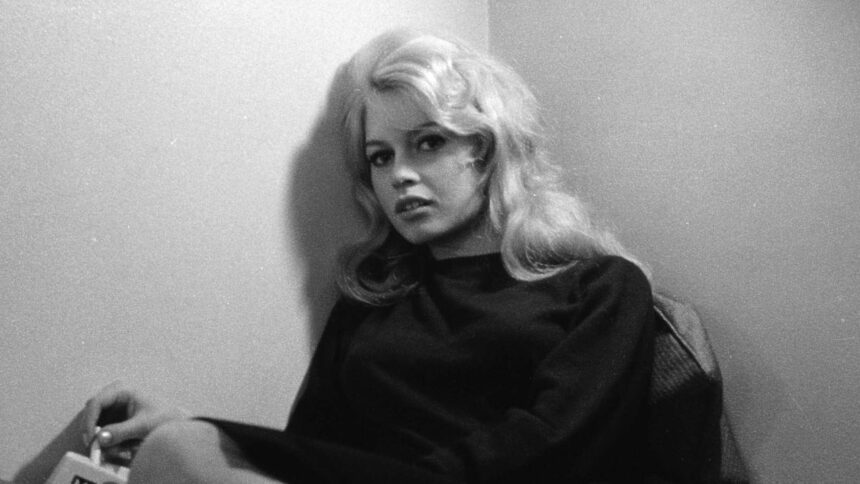
A memoir in photographs, Brigitte Bardot: My Life in Fashion, published this month by Flammarion, reprises the images and looks that made her—despite her professed indifference—an avatar of style. The top couturiers of the day, including Pierre Balmain, Christian Dior, and Dior’s successor, the young Yves Saint Laurent, dressed the starlet for grand occasions. But in Vadim’s movie she wore her own clothes—simple shirtdresses, form-fitting shifts, a dancer’s leotard—or nothing at all for her role as Juliette, a disarmingly free-spirited and lustful teenage orphan, who sunbathes naked and sows erotic mayhem around St.-Tropez. (The little fishing village, frequented by artists and a handful of cognoscenti, was not yet a favorite playground of the jet set.) Censors on both sides of the Atlantic were appalled.
Her loose, golden hair was like a banner waving in defense of the new hedonism and against a prior generation of “ladylike” French stars, with their corsets and stays, their careful coiffures, furs, and pearls. “I always tried to dress in a way that made me feel good,” Bardot says, “at ease in my own skin, comfortable in my clothing—and naked, too.” (Bardot could get “copyright credit,” her French biographer Marie-Dominique Lelièvre writes, “every time a girl in the street today fixes her hair by running her fingers through it.”)
Her great liberty on-screen was “natural.” Bardot says now. “I was just being me.” So natural, in fact, that having kissed her costar in the film, actor Jean-Louis Trintignant, she promptly fell in love with him, leaving husband Vadim for the first in a series of high-profile, often short-lived romances.
“In the game of love, she is as much a hunter as she is a prey,” Simone de Beauvoir proclaimed in the pages of Esquire, championing her as an unlikely feminist icon. (The men in her life—legendarily louche French pop star Serge Gainsbourg, for example, a disheveled dandy who, distraught in the wake of their brief affair, penned the ballad “Initials B.B.” in homage to her—had no influence on the way she dressed, she says. “Serge,” she purrs, “was really a very reserved and modest boy, and we loved each other madly.”) For the avant-garde, her untamable allure was a welcome form of anarchy. French New Wave director Jean-Luc Godard made it the centerpiece of his masterpiece Contempt (1963), and cultural heavyweights Marguerite Duras and Françoise Sagan devoted, respectively, an essay and a book to her.