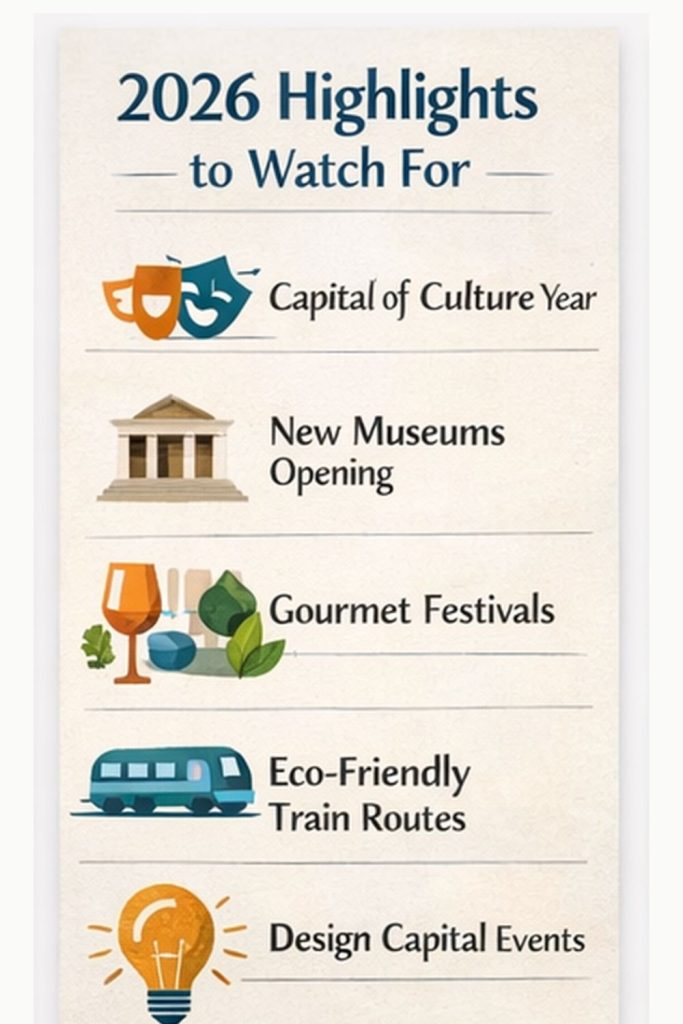
Europe’s overtourism problem has created a countertrend: a growing share of travelers actively seeking niche destinations and building trips around shoulder seasons, rail convenience, and cultural programming.
Euronews, citing a European Travel Commission report, notes 55% of travelers are looking for niche destinations and that avoiding crowds is becoming a priority.
Travel companies have followed the demand signal. Intrepid Travel’s 2026 “Not Hot List” argues that travel flows are overly concentrated—“Eighty per cent of travellers visit just 10 per cent of the world’s tourism destinations,” said Erica Kritikides, its general manager of Experiences.
The opportunity for 2026, then, is to visit places right before the calendar of events (and new infrastructure) turns them into the next obvious pick.
1) Oulu, Finland — Arctic-edge culture on a big year

Oulu is not merely “up and coming”; it is European Capital of Culture 2026, with programming built around the idea of “cultural climate change.” If you want to see a city in “festival mode” while it still feels local, 2026 is the moment.
2) Trenčín, Slovakia — a Capital of Culture that’s still off most radars

Slovakia’s Trenčín holds the same 2026 title, with the EU describing its slogan as “Awakening Curiosity.”
Unlike Europe’s permanent headliners, this is a year when a smaller city will be programmed like a capital—ideal for travelers who want culture without the crush.
3) Jerez de la Frontera, Spain — the food capital story you can time precisely
Jerez has been named Spain’s Capital of Gastronomy for 2026, with 54 activities planned across the year—wine and tapas events, cultural tours, and festivals. For event-driven travelers, the calendar gets even sharper: Vinoble 2026 (a major fortified and sweet wines fair) is scheduled for May 30–June 1, 2026 in the city.
4) Brussels, Belgium — a new museum opening with “big-city” gravitational pull

Brussels has long been underestimated as a leisure destination, but that is changing fast. The forthcoming KANAL–Centre Pompidou is scheduled to open November 28, 2026, and is positioned to be among Europe’s largest museums by exhibition space.
On the ground, the rhetoric is already “city-scale”: “Exactly one and a half years before the opening, we’re here today at the KANAL site,” said spokesperson Dieter Vanthournout during the announcement.
5) Saint-Gervais-les-Bains, France — a smarter Alpine base built around rail

In the Alps, 2026 is increasingly about car-light access. The century-old Mont Blanc Express will roll out a new fleet of energy-efficient trains in summer 2026, and highlights the already-launched Le Valléen gondola linking the mainline station to the resort center in minutes.
For travelers who want the mountain experience without peak-season chaos, that connectivity is a material shift.
6) Frankfurt am Main, Germany — design programming that can reframe a “transit city”

Frankfurt is still treated as an airport stop by many travelers. But in 2026 it becomes World Design Capital, under the banner “Design for Democracy,” with more than 2,000 events expected
That volume of programming is exactly how “secondary” cities get reclassified in public imagination.
7) Bled, Slovenia — a headline lake town with a genuinely new reason to go
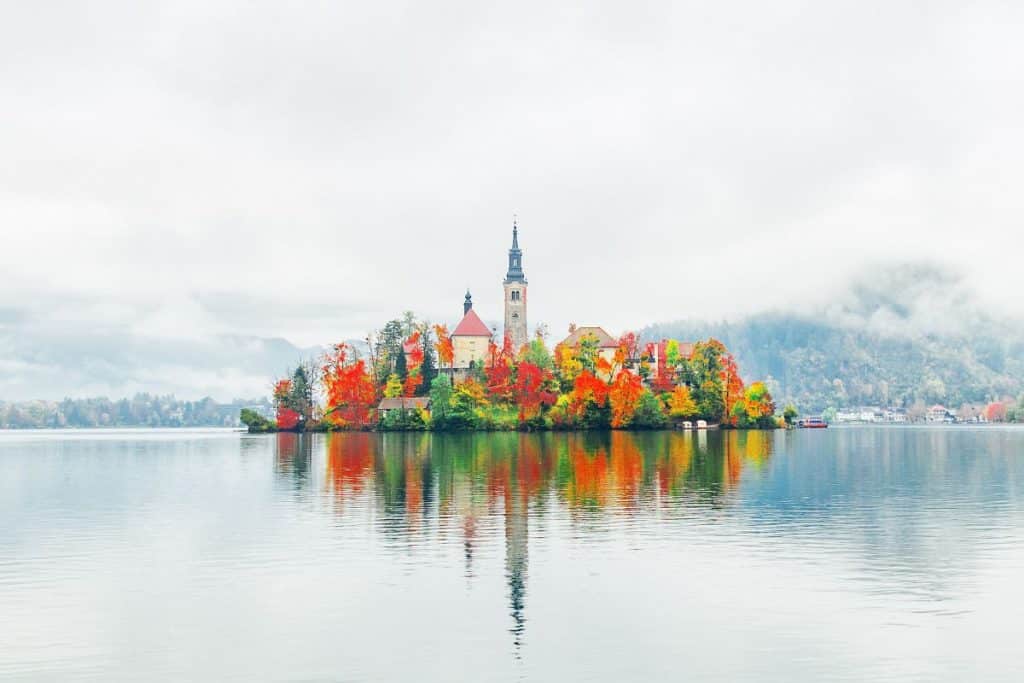
Bled is famous, but 2026 gives it a new cultural anchor: Muzej Lah, a contemporary art museum set to open in summer 2026.
For travelers who have “seen the lake” but skipped the longer stay, that opening is the kind of single datapoint that changes trip math.
Europe’s 2026 sweet spot is straightforward: go where the programming is rising faster than the crowds. The cities above have clear, reportable hooks—titles, openings, and calendar moments—that can anchor coverage now, while still serving practical trip planners.
Featured Image Source: onlyslovakia.com