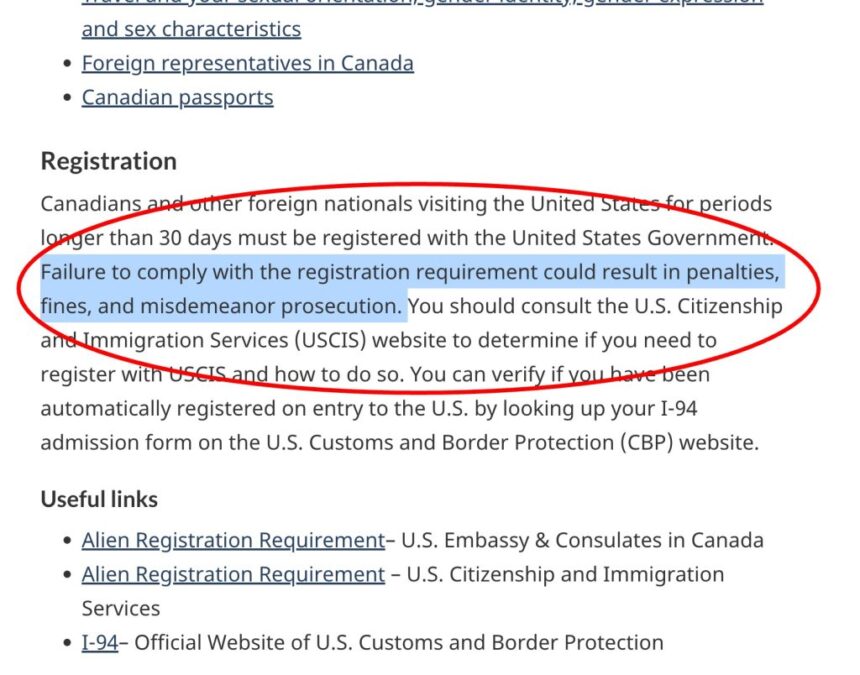
The Canadian government has updated its travel guidance for the United States to emphasize a long-standing but increasingly enforced U.S. requirement that can affect Canadians who stay south of the border for more than 30 days.
The advisory highlights that travelers who fail to comply with U.S. registration rules may face penalties, fines, and misdemeanor prosecution, a shift that arrives as cross-border travel demand has softened and as U.S. border enforcement practices remain under heightened scrutiny.
At the center of the guidance is a clear warning from Global Affairs Canada: “Failure to comply with the registration requirement could result in penalties, fines, and misdemeanor prosecution.”
What Changed for Canadians at the Border
Canada’s advisory does not describe a new Canadian policy so much as a reminder that U.S. authorities are enforcing existing rules more assertively, especially for travelers entering via land borders and planning extended stays. Reuters reported in March 2025 that the U.S. would begin enforcing a visitor registration requirement for Canadians entering by land, citing a New York Times report and U.S. officials.
Axios, summarizing the advisory and related U.S. policy moves, linked the registration focus to a broader tightening of immigration enforcement. The outlet also quoted a U.S. State Department official, underscoring that entry conditions will be applied: “We will enforce visa rules and other conditions of entry.”
The Rule Behind the Warning and Why It Matters
The Canadian advisory points travelers to U.S. resources and notes that visitors staying longer than 30 days must be registered, adding that travelers can check whether they were automatically registered by looking up an I-94 admission record on U.S. Customs and Border Protection systems.
While the legal framework predates the current moment, it has drawn renewed attention in U.S. courts and media. An Associated Press report described how a federal judge allowed the administration’s effort to enforce registration-and-carry-documentation requirements to proceed, noting the policy’s roots in older immigration statutes and its potential to expose noncompliance to fines or prosecution.
International coverage has also framed the issue as an enforcement shift affecting longer-stay Canadians, particularly those who historically crossed the land border without needing to think about formal “registration” beyond normal entry screening.
Who Is Most Exposed: Snowbirds, Extended Stays, and Land Crossings

The practical impact is concentrated among Canadians who spend weeks or months in the U.S.—notably snowbirds and others with longer stays. The Guardian reported that the requirement was expected to affect the estimated 900,000 snowbirds who winter in warmer U.S. states and cited a Department of Homeland Security estimate that millions could be affected by the broader registration approach.
Canadian media reporting on the advisory has similarly emphasized that the 30-day threshold is the key trip-planning trigger, and that travelers may be asked to demonstrate they remain temporary visitors.
Practical Compliance: How Travelers Can Reduce Risk
Canada’s guidance is concise—register if required, and confirm your status using U.S. systems—yet the real-world friction is that travelers may not know whether an I-94 exists for their trip. To help close that gap, the Canadian Snowbird Association has published step-by-step guidance explaining that travelers should retrieve and keep proof of an I-94 when it exists and use the USCIS online registration process when it does not.
For travelers planning 30+ days in the U.S., the operational takeaway is straightforward:
- Confirm whether you have an I-94 record associated with your entry and print or save proof.
- If no I-94 was issued for a long stay—an issue that can arise for some land entries—follow the U.S. registration pathway described by U.S. authorities and referenced by Canadian guidance.
- At the border, be prepared for questions that go to ties to Canada, the legitimacy and length of the trip, and ability to fund the stay—all factors explicitly listed in Canada’s advisory.
Beyond Registration: Added Border Scrutiny and Travel Patterns
Canada’s U.S. advisory also reminds travelers that U.S. border officers may scrutinize more than itinerary details. It states that U.S. agents may search electronic devices and can request passwords, with refusal potentially leading to seizure, delay, or denial of entry for non-U.S. citizens. The advisory recommends steps such as putting devices in airplane mode to avoid accidental syncing of remote files during inspection.
The warning arrives as cross-border travel volumes have declined. Statistics Canada reported that in August 2025, Canadian residents returned from 2.9 million trips to the United States, a 29.7% decrease from August 2024.
Separately, U.S. regional reporting has tied falling Canadian visitation to economic impacts in border communities, citing double-digit declines in passenger vehicle crossings in parts of the Pacific Northwest.
For Canadian travelers, the message from Ottawa is less about avoiding the United States than about recognizing that administrative compliance now carries higher practical stakes. For anyone planning an extended stay—particularly by land—confirming registration status and carrying documentation has become a core part of responsible trip planning.