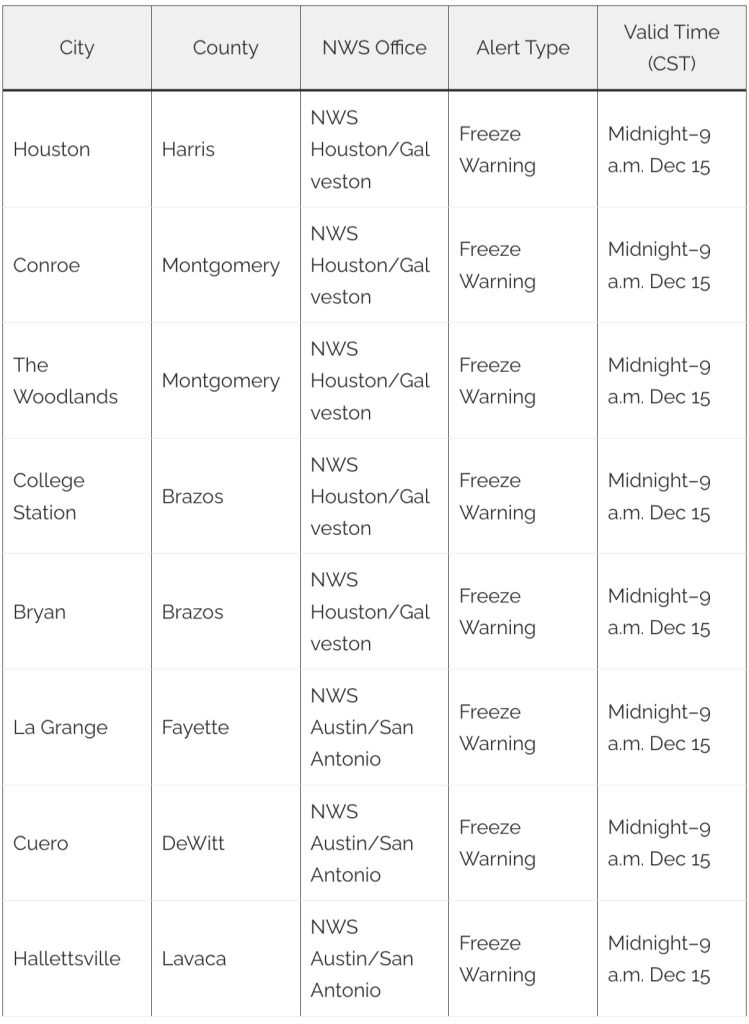
An early-season cold blast has pushed deep into Texas, triggering freeze warnings and hard-freeze alerts from Central Texas through the Houston metro and into portions of Southeast Texas.
The National Weather Service expects temperatures to fall to near or below freezing in many areas, marking the first freeze of the season for parts of the state and raising concerns about both infrastructure and road safety.
Texas Cities Explicitly Named in Freeze Warnings
Sources: mysanantonio.com, govonestop.com
Additional Major Cities Within Freeze-Warning Counties

In and around Houston, a freeze warning from midnight to 9 a.m. Monday calls for lows ranging from the mid-20s north of the city to the mid-30s near the coast.
Further west, counties near San Antonio, including DeWitt, Fayette, and Lavaca, are under similar alerts, with lows expected between 28°F and 32°F, described by local meteorologists as the first widespread freeze of the season for that region.
A broader outlook notes freeze warnings across parts of southeast Texas and neighboring Gulf states, with the NWS warning of subfreezing temperatures and elevated frostbite and hypothermia risk for anyone exposed without adequate protection.
While much of the public conversation focuses on protecting “people, pets, plants, and pipes,” the same cold air mass quietly creates a much more immediate hazard: black ice on bridges, overpasses, and untreated roads. A key reason Texas roads become especially dangerous is that most networks outside the Panhandle are not systematically pre-treated or plowed for brief cold snaps, unlike in northern states where repeated winter events justify extensive de-icing operations and driver experience.
TxDOT’s own winter-weather guidance underscores the seriousness of the issue. The agency notes that “winter weather creates unpredictable and dangerous driving conditions” and explicitly states that it “strongly advises you to stay off the roads” when snow and ice are present.
When travel is unavoidable, TxDOT directs motorists to use extreme caution and to consult its real-time highway conditions service, DriveTexas.org, which shows closures, crashes, and weather-related hazards across the state.
Safety experts point out that bridges and overpasses freeze first, because cold air circulates above and below the concrete, chilling it faster than the ground-connected pavement. Guidance widely used in driver-safety materials warns that even at or just above freezing, shaded or elevated sections can harbor hidden ice.
Officials in other states have documented how “even a thin layer of ice accumulations … can cause significant disruptions and wrecks, especially [on] elevated” roadways, a principle that applies equally to Texas’s flyovers and long river bridges.
In Texas, those vulnerabilities are magnified by design and behavior. High speed limits on rural interstates and farm-to-market roads can leave drivers little time to react when they unexpectedly hit a slick patch. Many motorists, particularly in South and Central Texas, have limited experience driving on ice and may not instinctively reduce speed, increase following distance, or avoid cruise control in freezing conditions. TxDOT’s snow and ice guide stresses the need to slow down, brake gently, and avoid sudden maneuvers to maintain control.
Urban work zones add another layer of complexity. Major metros such as Houston, Austin, and San Antonio are in the midst of long-term highway expansion and interchange projects. Travel information from Texas Highways and TxDOT notes that DriveTexas’s interactive map highlights construction zones alongside weather-related hazards, illustrating how narrowed lanes and changing traffic patterns intersect with cold-weather risks.
In freezing conditions, these constricted segments become bottlenecks where any loss of traction can quickly trigger multi-vehicle collisions and extended closures.
Public agencies across Central Texas are urging residents to sign up for localized alerts and to monitor both weather forecasts and road-condition tools. The Austin American-Statesman highlights the Warn Central Texas system, local emergency management channels, and TxDOT’s mapping platform as key resources for keeping track of freeze alerts, health advisories, and transportation impact.
As one TxDOT winter safety notice puts it, “Winter weather creates unpredictable and dangerous driving conditions. TxDOT strongly advises you to stay off the roads.”
For Texans facing this morning’s freeze warnings, the message is clear: even brief periods of subfreezing temperatures can turn familiar roads into hazardous ones, and the safest strategy is to slow down, stay informed, and avoid unnecessary travel until temperatures rise above freezing and road conditions stabilize.