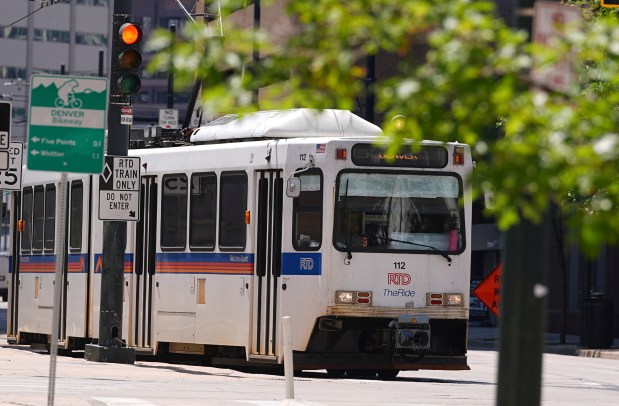
ENGLEWOOD — Metro Denver budtender Quentin Ferguson wants Regional Transportation District bus and trains to succeed in work at an Arvada dispensary from his home, a visit that takes 90 minutes every approach “on day.”
“It’s fairly inconvenient,” Ferguson, 22, mentioned on a current wet night, ready for an almost empty practice that was eight minutes late.
He’s not complaining, nevertheless, as a result of his comparatively low revenue and Medicaid standing qualify him for a reduced RTD month-to-month go. That lets him get monetary savings for a automotive or an electrical bicycle, he mentioned, both of them providing a quicker commute.
Then he would not should experience RTD.
His plight displays a core downside of lagging ridership that RTD administrators more and more run up in opposition to as they attempt to place the transit company as the neatest technique to navigate Denver. Most different U.S. public transit businesses, too, are grappling with a model of this downside.
In Colorado, state-government-driven efforts to pay attention the rising inhabitants in high-density, transit-oriented improvement round bus and practice stations — a precedence for legislators and Gov. Jared Polis — hinge on having a swift public system that residents experience.
However transit ridership has didn’t rebound a yr after RTD’s havoc in 2024, when operators disrupted service downtown for a $152 million rail reconstruction adopted by a systemwide emergency upkeep blitz to clean deteriorating tracks that led to trains crawling by means of 10-mph “sluggish zones.”
The newest ridership numbers present an total decline this yr, by not less than 3.9%, with 40 million fewer riders per yr in contrast with six years in the past. And RTD executives’ newly proposed, record $1.3 billion budget for 2026 doesn’t embrace funds for enhancing bus and practice frequency to win again riders.
Frustrations intensified final week.
“What’s the level of transit-oriented improvement whether it is simply improvement?” mentioned state Rep. Meg Froelich, a Democrat representing Englewood who chairs the House Transportation, Housing and Local Government Committee. “We’d like dependable transit to have transit-oriented improvement. We now have cities which have invested vital sources into their transit-oriented communities. RTD shouldn’t be holding up its finish of the cut price.”
At a retreat this previous summer season, a majority of the RTD’s 15 elected board members agreed that boosting ridership is their prime precedence. Some who reviewed the proposed budget final week questioned the dearth of spending on service enhancements for riders.
“We’re not shifting the needle. Ridership shouldn’t be going up. It must be going up,” director Karen Benker mentioned in an interview.
“Over the previous few years, there’s been an amazing quantity of inhabitants progress. There are such a lot of condo complexes, a lot new housing put up throughout,” Benker mentioned. “Transit needs to be relied on. You simply can’t preserve constructing extra roads. We’re going to have to seek out methods to get individuals to experience public transit.”
Commuting tendencies blamed
RTD Chief Government and Normal Supervisor Debra Johnson, in emailed responses to questions from JS, emphasised that “RTD shouldn’t be distinctive” amongst U.S. transit businesses struggling to regain ridership misplaced through the COVID-19 pandemic. Johnson blamed societal shifts.
“Commuting tendencies have considerably modified over the past 5 years,” she mentioned. “Return-to-work numbers within the Denver metro space, which accounted for a major share of RTD’s ridership previous to March 2020, stay low as corporations and companies proceed to offer versatile in-office schedules for his or her staff.”
Sooner or later, RTD can be “altering its focus from primarily offering commuter providers,” she mentioned, towards “enhancing its bus and providers and connections to high-volume occasions, exercise facilities, live shows and festivals.”
A current survey commissioned by the agency discovered distinctive buyer satisfaction.
However company administrators are in search of a extra aggressive method to reversing the decline in ridership. And a few are mulling a radical restructuring of routes.
Funded largely by taxpayers throughout a 2,345 square-mile space spanning eight counties and 40 municipalities — one of many greatest within the nation — RTD operates 10 rail traces overlaying 114 miles with 84 stations and 102 bus routes with 9,720 stops.
“We must always begin from scratch,” mentioned RTD director Chris Nicholson, advocating an overhaul of the “geometry” of all bus routes to align transit higher with metro Denver residents’ present mobility patterns.
The important thing can be growing frequency.
“We must always design the routes how we expect would finest serve individuals at the moment, after which we might take that and modify it the place completely essential to keep away from disruptive variations with our present route map,” he mentioned.
Then, in 2030, administrators ought to attraction to voters for elevated funding to enhance service — funds that will be considerably managed by municipalties “to select the place they need the service to go,” he mentioned.
Reversing the RTD ridership decline might take a few years, Nicholson mentioned, evaluating the decreases this yr to prospects shunning a restaurant. “Should you’re a restaurant and also you poison some company by accident, you’re gonna lose prospects even after you repair the issue.”
The RTD ridership numbers present an total public transit ridership lower by 5% when measured over the 12-month interval from August 2024 by means of July 2025, the final month for which staffers have made numbers obtainable, in contrast with the identical interval a yr in the past.
Bus ridership decreased by 2% and light-weight rail by 18% over that interval. In a typical month, RTD officers report round 5 million boardings — round 247,000 on weekdays.
The emergency upkeep blitz started in June 2024 when RTD officers revealed that inspectors had discovered widespread “rail burn” deterioration of tracks, compelling 1000’s of riders to hunt different transportation.
The precautionary rail “sluggish zones” continued for months as contractors labored on tracks, delaying and diverting trains, leaving transit-dependent staff in a lurch. RTD driver workforce shortages restricted deployment of emergency bus shuttles.
This yr, RTD ridership systemwide decreased by 3.9% when measured from January by means of July, in contrast with that interval in 2024. The bus ridership this yr has decreased by 2.4%.
On rail traces, the ridership on the comparatively common A Line that runs from Union Station downtown to Denver International Airport was down by 9.7%. The E Line gentle rail that runs from downtown to the southeastern fringe of metro Denver was down by 24%. Rail ridership on the W Line decreased by 18% and on R Line by 15%, agency records present.
The annual RTD ridership has decreased by 38% since 2019, from 105.8 million to 65.2 million in 2024.
Mild rail ‘illness’ spreading
“The illness on RTD gentle rail is spreading to different elements of the RTD system,” mentioned James Flattum, a co-founder of the Greater Denver Transit grassroots rider advocacy group, who additionally serves on the state’s RTD Accountability Committee. “We’re seeing everlasting demand destruction as a consequence of getting an unreliable system. This comes from a lack of belief in RTD to get you the place you’ll want to go.”
RTD officers have countered critics by stating that the sunshine rail’s on-time efficiency recovered this yr to 91% or higher. Bus on-time efficiency nonetheless lagged at 83% in July, company information present.
The officers additionally pointed to decreased safety experiences made utilizing an RTD smartphone app after deploying extra cops on buses and trains. The variety of reported assaults has decreased — to 4 in September, in contrast with 16 in September 2024, information present.
Better Denver Transit members acknowledged that security has improved, however query the company’s assertions primarily based on app utilization. “It might be true that the variety of safety calls went down,” Flattum mentioned, “however possibly the individuals who in any other case would have made extra security calls are not driving RTD.”
RTD staffers creating the 2026 price range have targeted on managing debt and sustaining operations spending at present ranges. They’ve obtained forecasts that revenues from taxpayers will enhance barely. It’s unclear whether or not state and federal funds can be obtainable.
Trying forward, they’re additionally planning to tackle $539 million of debt over the following 5 years to purchase new diesel buses, as a substitute of shifting to electrical hybrid buses as deliberate for the longer term.
RTD administrators and leaders of the Southwest Energy Efficiency Project, an environmental group, are opposing the rollback of RTD’s deliberate shift to the cleaner, quieter electrical hybrid buses and taking up new debt for that function.
Colorado lawmakers will “push on a bunch of various fronts” to prioritize higher service to spice up ridership, Froelich mentioned.
The legislature in recent times directed funds to assist RTD present free transit for riders below age 20. Buses and trains working not less than each quarter-hour would enhance each ridership and security, she mentioned, as a result of extra riders would discourage dangerous habits and riders wouldn’t have to attend alone at night time on often-empty platforms for as much as an hour.
“We’re attempting to do what we are able to to get individuals again onto the transit system,” Froelich mentioned. “They do it elsewhere, and folks right here do experience the Bustang (intercity bus system). RTD simply appears to lack the nimbleness required to fulfill the second.”

Riders change modes
In the meantime, riders proceed to desert public transit when it doesn’t meet their wants.
For Denver Center for the Performing Arts theater technician Chris Grossman, 35, ditching RTD led to a greater high quality of life. He needed to transfer from the Virginia Village neighborhood he beloved.
Again in 2016, Grossman offered his ailing blue 2003 VW Golf when he moved there within the perception that “RTD gentle rail was roughly dependable.” He rode almost each day between the Colorado Station and downtown.
However trains grew to become erratic as upkeep of partitions alongside tracks prompted delays. “It simply received so dangerous. I used to be burning a lot cash on rideshares that I in all probability might have purchased a automotive.” Shortly earlier than RTD introduced the “sluggish zones” final summer season, he moved to an condo nearer to downtown on Capitol Hill.
He walks or rides scooters to work, quicker than taking the bus, he mentioned.
Equally, Honor Morgan, 25, who got here to Denver from the agricultural Midwest, “grateful for any public transit,” mentioned she needed to transfer from her place east of downtown to be nearer to her office as a consequence of RTD transit bother.
Buses have been late, and one blew by her as she waited. She needed to alter her apparel when driving her Colfax Avenue path to Union Station to handle harassment. She confronted common dramas of riders with substance-use issues erupting.
Morgan moved to an condo close to Union Station in March, permitting her to stroll to work.
She nonetheless hoped to depend on RTD for live shows and nightlife, and to succeed in DIA for work-related flights not less than as soon as a month. However RTD social media posts have alerted her to sufficient delays on the A Line that she not trusts it, she mentioned. To cut back her “nervousness” and reduce the chance of lacking her flights, she shells out for rides — regardless that these usually get caught in site visitors.
She and her boyfriend just lately tried RTD once more, driving a practice to the thirty eighth and Blake Station close to the Mission Ballroom. They attended “an incredible live performance” there, she mentioned, and felt glad as they walked to the station to catch the practice house.
A person on the platform collapsed backward, hitting his head. He was bleeding. She referred to as 911. Her boyfriend and different riders gathered. She ran throughout the road to an condo constructing and grabbed paper towels. RTD isn’t actually responsible, however “I simply want that they had a station platform attendant, or somebody. I have no idea head-injury first help,” Morgan mentioned.
The practice they’d been ready for got here and went. An ambulance arrived. They received house late, the night ruined, she mentioned.
“His head cracked open. He had pores and skin flaps hanging off his head. This was caught in my head, not less than for the remainder of the night time.”
Get more Colorado news by signing up for our Mile High Roundup email newsletter.