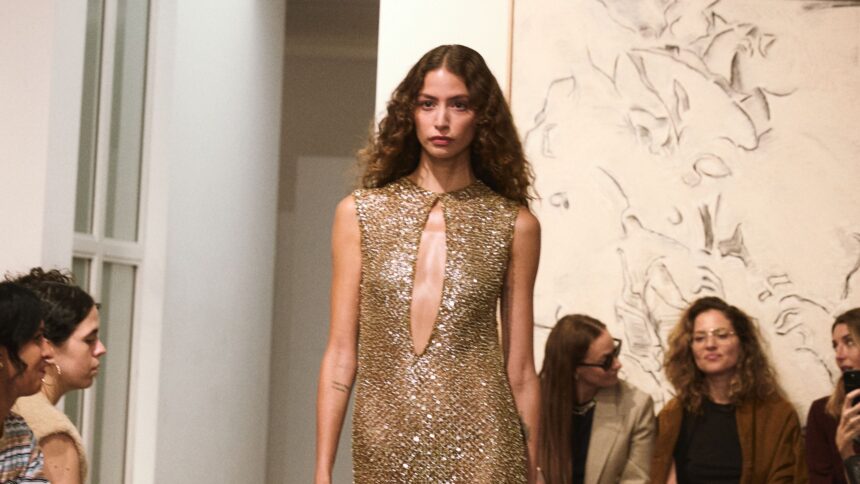
After a marathon of exhibits marked by vibrant lights, pulsating soundtracks, and late begin occasions (VIPs aren’t identified for punctuality) the very last thing any editor needs to do is finish New York Style Week with extra of the identical. So whether or not it was by design or by coincidence, Amir Taghi’s inaugural runway presentation—intimate, relaxed, and held on the final days of exhibits—was a perfect technique to shut out the week.
“We’ve been toggling backwards and forwards, considering, ‘When are we going to do a present? Is it the appropriate time? Ought to we wait?’” mentioned Taghi after debuting his spring 2026 assortment on the Hunter Dunbar gallery in Manhattan’s Chelsea neighborhood. “We’ve been doing lookbooks which might be shot superbly, they usually’ve been working, however this season we ended up doing a present as a result of we have been in a position to invite our neighborhood.” That neighborhood is basically composed of purchasers who’ve supported the label since inception. They have been simply as delighted to fly themselves to New York as they have been to be wearing Amir Taghi for the runway present and a personal cocktail celebration later that night time.
“I’ve been designing collections for some time, however I’d say the start of the model was round 2020, proper earlier than Covid,” Taghi mentioned. “In a whole lot of methods, everybody was freaking out, however for me and the model, it offered the time to essentially uncover who we wished to be, who we have been promoting to, and our identification.” Taghi described his namesake vary as “eccentric, textured, tailor-made, and nuanced”—aesthetics honed interning at Oscar de la Renta whereas the late designer was on the helm; finding out at Central Saint Martins and Parsons; and later working in design at Monse, Proenza Schouler, and Adam Lippes.
“There are all the time 4 or 5 completely different beginning factors,” Taghi mentioned of how his collections come collectively. For spring 2026, certainly one of them was the headscarves ladies are required to put on in Iran, the place Taghi’s household is initially from. Although the designer vehemently opposes the mandate, “it has form of pressured Iranian ladies to make use of scarves as a technique to describe themselves,” he mentioned. On the present, a black and white scarf-hem costume seemingly floated down the runway, whereas a colourful silk scarf was draped over a pair of trousers like a sarong and tied beneath the collar of a peplumed nappa leather-based jacket. An elongated single-button blazer, black suiting, and a structured cream bar jacket all pointed to Taghi’s affinity for menswear. “When my grandfather moved from Iran to the U.S.—to Houston, again within the Nineteen Eighties—he gave my uncles seed cash to open their very own menswear retailer,” he mentioned. “It was the time of Armani, Zegna and Versace, so rising up inside that atmosphere, I’ve all the time liked tailoring.