There are lots of theories on tips on how to finest deal with a uncommon (however potential) cataclysmic asteroid collision with Earth. Successfully testing these potential options in opposition to precise house rocks, nonetheless, is advanced, expensive, and takes years to realize. Now, researchers consider they created a neater method (comparatively talking) to evaluate one of the dramatic proposals: deploying a nuclear bomb. To drag off their current experiments, a staff at Sandia Nationwide Laboratories devised a brand new device they name “X-ray scissors.”
In 2022, NASA’s Double Motion Redirection Check (DART) mission efficiently altered an asteroid’s trajectory after slamming a spacecraft into the roughly 560-foot-wide rock at 13,000 mph. Whereas a significant second in researching contingency plans for deflecting catastrophic Earthbound asteroids, the general venture wasn’t low-cost. All instructed, the mission price round $324.5 million to finish. Which means planning quite a few repeat performances isn’t a possible technique to additional examine asteroid deflection. However should you may simulate an asteroid, its environment, and nuclear blast forces in a lab, then that may make many mannequin experiments potential.
[Related: What would we do if an asteroid slammed Earth on July 12, 2038?]
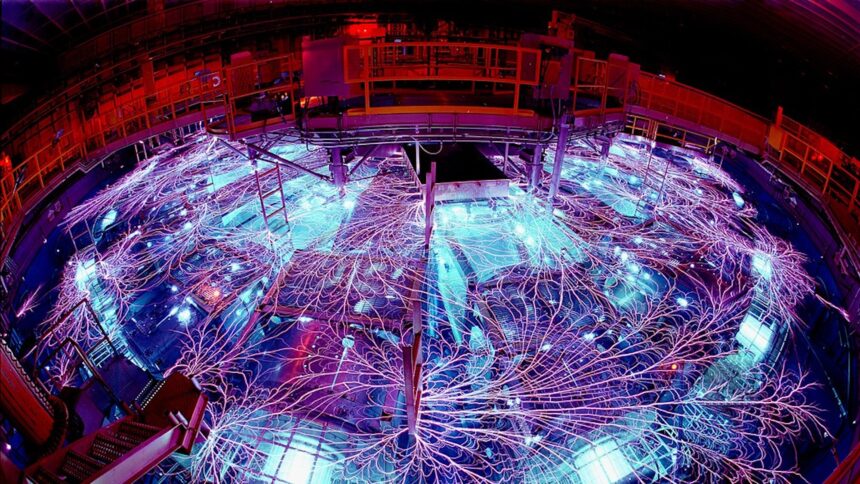
To approximate a nuclear detonation, a staff led by Sandia Nationwide Laboratories physicist Nathan Moore relied on the establishment’s room-sized “Z machine,” the world’s strongest pulsed-power gadget. As National Geographic explains, as soon as the Z machine is activated, argon gasoline receives an enormous blast of electrical energy inflicting it to blow up into tremendous sizzling plasma just like the floor of the Solar. This plasma additionally creates megajoule-sized bursts of X-ray radiation, just like a nuclear detonation in house. The cumulative impact is so highly effective that the Z machine can melt diamonds.
Moore’s staff theorized that putting a miniature asteroid imitation contained in the goal chamber may simulate a lot bigger house rock eventualities involving precise nukes. However there’s only one persistent drawback on Earth—gravity.
“[A]steroids in outer house aren’t hooked up to something. However in a lab, every little thing is pulled down by Earth’s gravity, so every little thing is held in place by its gravitational attachment to one thing else,” Moore defined in a September 23 announcement. What’s extra, gravity prevents any mannequin asteroids from precisely transferring as they’d in house, whereas any mechanical attachments generate friction.
Moore and colleagues name their workaround “X-ray scissors.” First, researchers suspended 0.1 g of silica within the Z machine’s goal chamber utilizing a chunk of foil roughly eight occasions thinner than a single human hair. That ultrathin anchor instantly vaporized because the Z machine fired its X-ray burst. For the briefest of moments, the unsuspended silica pattern existed in a free-floating state with none gravitational influences.
[Related: 5 ways we know DART crushed that asteroid (but not literally)]
“For a one-nanometer fall, we will ignore Earth’s gravity for 20 millionths of a second as Z produces a burst of X-rays that sweeps over the mock-asteroid floor 12.5 millimeters throughout, concerning the width of a finger,” mentioned Moore.
In that 20 millionths of a second, extraordinarily delicate gear measured the silica stand-in’s influence drive and velocity, which the staff then plugged right into a mannequin able to simulating exponentially bigger asteroids and nuclear forces. The outcomes have been revealed within the September 23 subject of Nature Physics, and showcase the early phases within the institution of a library of nuke-like results on scale mannequin asteroids. From there, computational modeling could quickly assist consultants run dozens of asteroid deflection trials with out the necessity for precise asteroids, nuclear weapons, or rocketry.
There may be nonetheless a protracted option to go earlier than researchers think about launching nuclear bombs at incoming asteroids a viable resolution to stave off impending doom—and there’s purpose to consider it might by no means turn out to be a practical resolution. Asteroids aren’t solely composed of silica, however an array of various minerals. Generally, they aren’t even a single rock, however a bunch of many smaller particles items caught collectively by their collective gravitational pull. All of those variables must be studied and addressed earlier than hurling an enormous bomb into house. However the Z machine and its X-ray scissors presumably present a primary step in the direction of such a future.
“To most individuals, the hazard from asteroids appears distant,” mentioned Moore. “However our planet is hit by BB-sized asteroids each day. We name them capturing stars. We don’t wish to look forward to a big asteroid to indicate up after which scramble for the precise technique to deflect it.”