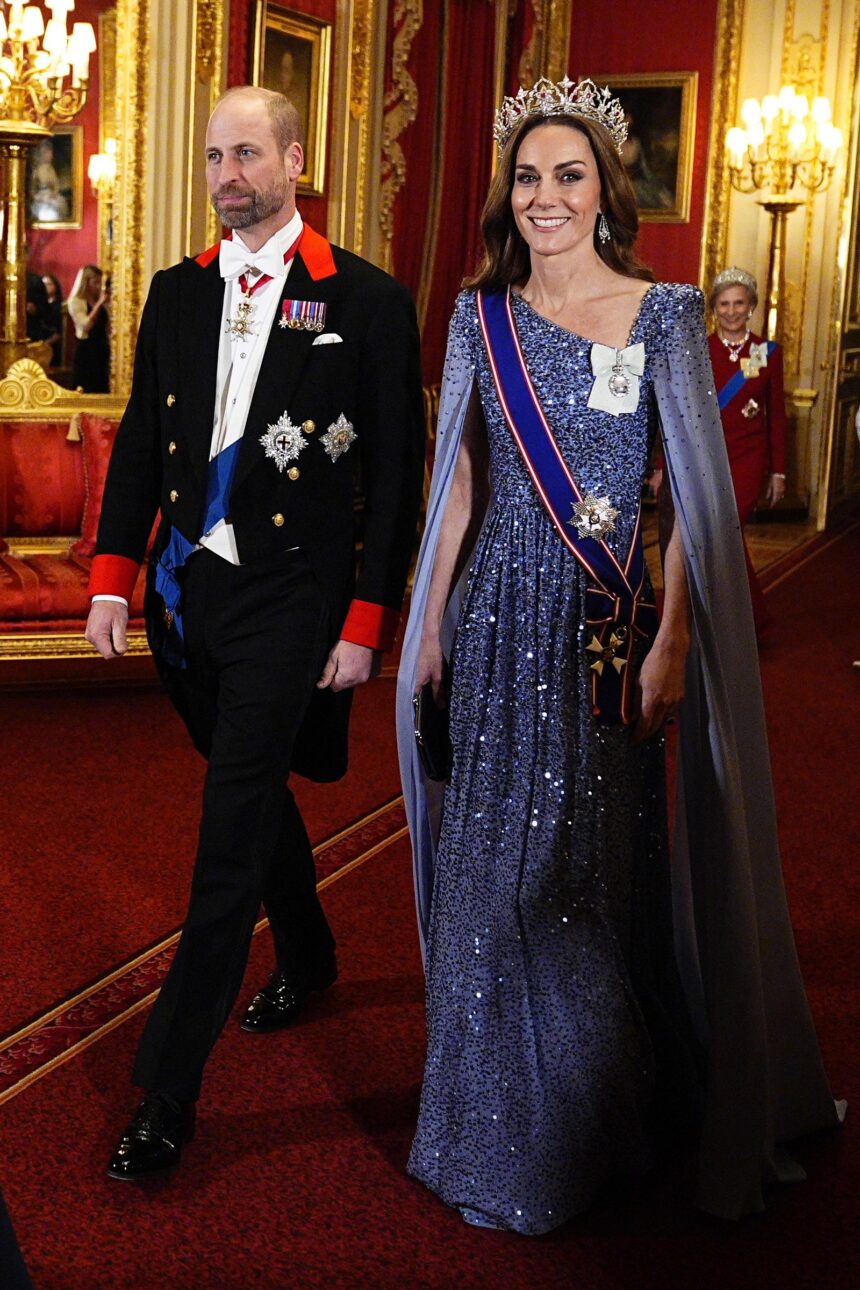
When the Princess of Wales arrived at Windsor Castle for the state banquet held in honour of German President Frank-Walter Steinmeier earlier this month, she surprised royal watchers with her choice of tiara for the occasion. While in the past she’s typically favored the Cartier Lover’s Knot (famously worn by Princess Diana) and the Lotus Flower (which she memorably chose for Chinese President Xi Jinping’s state visit in 2015), this time around, she opted for the Oriental Circlet tiara, which was made by Garrard in 1853 for Queen Victoria.
Featuring diamonds and rubies in a lotus flower and Mughal arch motif, the tiara—which was worn once by the late Queen Elizabeth II during a trip to Malta in 2005—is the largest diadem seen on Kate to date. Together with her dazzling blue caped gown (a favorite silhouette for the Princess) by Jenny Packham, her Royal Family Order of King Charles III brooch (first debuted in July 2025), and sash (which represents her position as a Dame Grand Cross of the Royal Victorian Order), the regal look signified how the Princess is increasingly embracing her role as queen in waiting.

In fact, we’ve had several tiara moments from Kate this year, thanks to French President Emmanuel Macron’s state visit in July and US President Donald Trump’s visit in September. For the former, the Princess opted for a burgundy caped gown by Sarah Burton for Givenchy—her first look by the designer since she took the helm of the French fashion house—and for the latter, a white Phillipa Lepley gown with a gold high-neck lace overcoat. Both choices marked a style shift from her previous state banquet looks, which have tended to veer more traditionally “princess-y.” (Think of the white ruffled Alexander McQueen gown she sported for President Trump’s first state visit.) This year’s more elaborate, covered-up gowns are arguably a sign of Kate’s growing seniority within the royal family.
Similarly, the Princess of Wales’s choice of a blush-pink Dior Bar jacket and tulle skirt, which she wore to greet Macron and his wife Brigitte at the start of their state visit, was a noticeable step change from the royal. Although she’s always been the queen of diplomatic dressing (consider the time she wore a maple-leaf brooch during her tour of Canada in 2011, or her sky-blue jumper in support of Ukraine in 2022), the choice of the French house—her first time wearing the brand—was indicative of a willingness to embrace fashion with a capital F, at least for select high-profile engagements.


In many ways, the obvious symbolism imbued in Kate’s state visit looks directly contrasted with a report in The Sunday Times in February, which suggested that Kensington Palace would no longer be releasing details of Kate’s outfits (something it never routinely did in the first place). “She wants the focus to be on the really important issues, the people and the causes she is spotlighting,” a source told the newspaper at the time. “There will always be an appreciation of what the Princess is wearing from some of the public and she gets that. But do we need to be officially always saying what she is wearing? No.”
The story caused such a furore that the Palace later backtracked, with a spokesperson telling People that the comments were not from the Princess herself, and that “there has been no change in our approach to sharing information about Her Royal Highness’s clothing.”


Still, the report was reflective of a different side of Kate’s approach to fashion—one that does say, “Don’t look at me, but instead at the causes that I’m supporting.” It’s why the Princess has preferred to stick to a royal uniform over the years—often comprising Catherine Walker coat dresses, Alexander McQueen tailoring, and Self-Portrait two-in-one skirt suits—and arguably one of the reasons why she so often rewears pieces from her own wardrobe.